

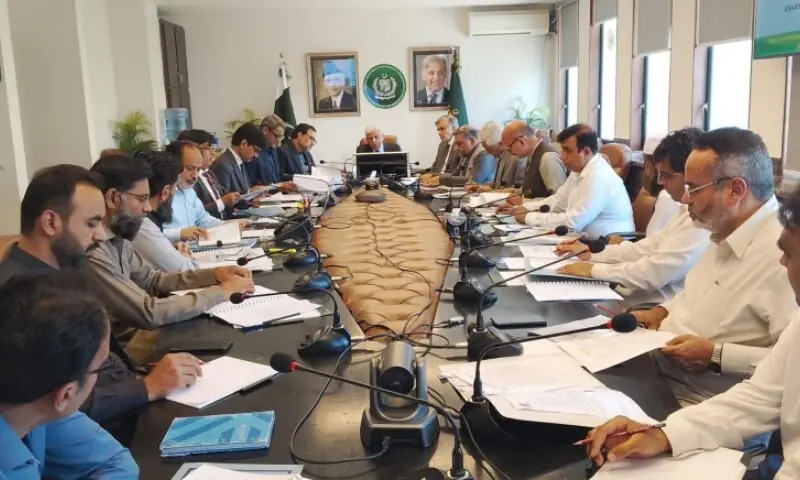
ISLAMABAD: As the Rabi crop season nears completion, with wheat as the strategic crop ensuring the country’s food security, the federal government on Tuesday announced production targets for the upcoming Kharif crop season. Soil moisture, especially in major agricultural plains, remains under stress due to drier conditions in previous months. The Federal Committee on Agriculture (FCA), a high-powered body chaired by Minister for National Food Security and Research Rana Tanveer Hussain, fixed a production target of 9. 17 million tonnes for rice, an important Kharif cash crop, to be cultivated over 3. 39 million hectares. For the upcoming Kharif sowing season, paddy seed availability stands at 60, 190. 69 metric tonnes, including 3, 660. 04 metric tonnes of imported seed, which is 110 per cent of the total national requirement of 54, 916 metric tonnes. The availability of quality paddy seed in Punjab is 45, 323. 80 metric tonnes (126 per cent), Sindh 8, 832 metric tonnes (56 per cent), Khyber Pakhtunkhwa 1, 116. 07 metric tonnes (114 per cent), and Balochistan 1, 258. 78 metric tonnes (58 per cent) of their respective provincial requirements. During 2025-26, total paddy seed availability was 44, 613 metric tonnes. Sugarcane The production target for sugarcane has been set at 80. 3 million tonnes over an area of 1. 14 million hectares. Sugarcane provides raw material to the country’s second-largest agro-based industry, generating employment for millions in rural farming and non-farming communities. It is also a major source of livestock fodder during the winter season. Sugar production for 2025-26 is projected at 6. 15 million tonnes, a 6pc decline from the previous year due to flood damage, lower yields, and reduced sucrose recovery. Cotton The FCA set a cotton production target of 9. 64 million bales over an area of 2. 16 million hectares for the upcoming season. Cotton production during 2025–26 reached 7. 054 million bales against a target of 10. 18 million bales, achieving only about 69 per cent, indicating a significant shortfall. In Punjab, the area under cotton cultivation is declining as farmers shift towards more profitable alternative crops. A severe heatwave in June caused significant stress to cotton plants, adversely affecting pollination and increasing fruit shedding. Floods in Punjab destroyed approximately 5. 2 per cent of the cultivated cotton area, further constraining production. In Balochistan, although cotton cultivation has slightly increased over the years, the area remains well below the target. Discussing agricultural inputs for Kharif crops, the committee was informed that water availability at canal heads is expected to remain at 67. 451 million acre-feet (MAF) during the season. The Met Office reported that above-average rainfall from March to early April has somewhat improved the situation across most parts of the country. It was further noted that expected rains in April and May, along with rising temperatures in northern areas, may improve water availability in major reservoirs. However, isolated heavy showers, hailstorms, and windstorms may disrupt Rabi crop harvesting, particularly in upper and central regions. Targets for other crops such as mung, mash, and chilies were also set. The production target for mung beans is 156. 4 thousand tonnes over 170. 6 thousand hectares, while mash is targeted at 8. 9 thousand tonnes over 10 thousand hectares. Chili production is set at 154. 4 thousand tonnes over 58. 4 thousand hectares. Secretary National Food Security and Research Saif Anjum informed the meeting that record potato production this year is a positive development but has also created challenges, particularly overproduction and declining market prices, affecting farmers’ profitability. This situation highlights the need for better planning and coordination in crop sowing. The targets and acreage decisions finalised by the FCA must be effectively implemented by provinces to ensure balanced production aligned with market demand. The government is making progress in exploring new international markets for exporting potatoes and other agricultural commodities. This will help manage surplus production, enhance export potential, and strengthen the rural economy, he said. Total availability of urea during Kharif 2026 is estimated at 4, 348 thousand tonnes, while DAP availability is estimated at 757 thousand tonnes. The committee was also informed that rice and maize seed availability will remain sufficient. A State Bank representative stated that institutional agricultural credit is expected to reach Rs3, 062 billion in fiscal year 2026. Published in Dawn, April 15th, 2026
Govt sets Kharif targets amid water stress, cotton shortfall

RELATED ARTICLES


