

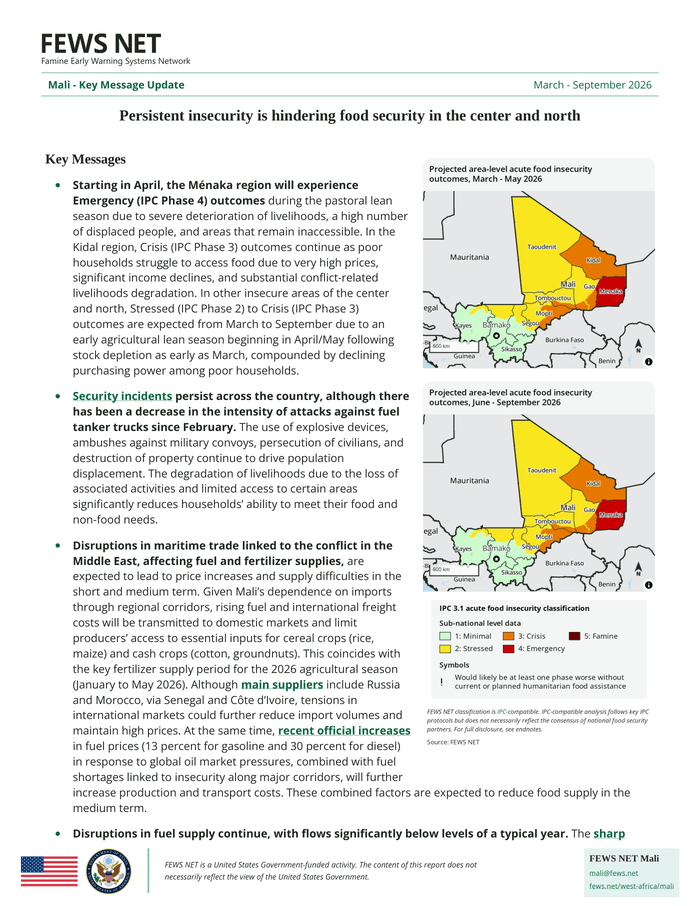
Country: Mali Source: Famine Early Warning System Network Please refer to the attached file. Key Messages Starting in April, the Ménaka region will experience Emergency (IPC Phase 4) outcomes during the pastoral lean season due to severe deterioration of livelihoods, a high number of displaced people, and areas that remain inaccessible. In the Kidal region, Crisis (IPC Phase 3) outcomes continue as poor households struggle to access food due to very high prices, significant income declines, and substantial conflict-related livelihoods degradation. In other insecure areas of the center and north, Stressed (IPC Phase 2) to Crisis (IPC Phase 3) outcomes are expected from March to September due to an early agricultural lean season beginning in April/May following stock depletion as early as March, compounded by declining purchasing power among poor households. Security incidents persist across the country, although there has been a decrease in the intensity of attacks against fuel tanker trucks since February. The use of explosive devices, ambushes against military convoys, persecution of civilians, and destruction of property continue to drive population displacement. The degradation of livelihoods due to the loss of associated activities and limited access to certain areas significantly reduces households’ ability to meet their food and non-food needs. Disruptions in maritime trade linked to the conflict in the Middle East, affecting fuel and fertilizer supplies, are expected to lead to price increases and supply difficulties in the short and medium term. Given Mali’s dependence on imports through regional corridors, rising fuel and international freight costs will be transmitted to domestic markets and limit producers’ access to essential inputs for cereal crops (rice, maize) and cash crops (cotton, groundnuts). This coincides with the key fertilizer supply period for the 2026 agricultural season (January to May 2026). Although main suppliers include Russia and Morocco, via Senegal and Côte d’Ivoire, tensions in international markets could further reduce import volumes and maintain high prices. At the same time, recent official increases in fuel prices (13 percent for gasoline and 30 percent for diesel) in response to global oil market pressures, combined with fuel shortages linked to insecurity along major corridors, will further increase production and transport costs. These combined factors are expected to reduce food supply in the medium term. Disruptions in fuel supply continue, with flows significantly below levels of a typical year. The sharp decline in diesel availability — more commonly used for transport — observed in Bamako and other urban centers in the south and center (Ségou, Koulikoro, Nara, Bandiagara, San, Koutiala, Mopti, and Douentza) is reducing population movement and trade flows. Shortages and rising costs of goods and transport, along with recent official fuel price increases, are further exacerbating tensions. This situation is worsened by power outages in urban centers, which disrupt economic activities — including industrial operations and off-season agricultural production — and erode household purchasing power. In the areas most affected by the fuel crisis in the center and south, poor households are resorting to atypical coping strategies such as selling assets and taking on excessive debt. According to key informants, prospects for off-season production are expected to be below average for market gardening and rice due to the impacts of fuel shortages, insecurity, and high agricultural input (fertilizer) prices, which have reduced cultivated areas. In contrast, flood-recession crops are expected to be average, supported by average water levels in ponds and lakes. As a result, harvests of market garden products and weeding activities for off-season rice offer only average to below-average opportunities for income and food, particularly in insecure areas. In central and northern regions, household access to food is reduced due to low stock availability and high cereal prices, including increases of 44 percent in Ménaka and 32 percent in Kidal in February 2026 compared to the five-year average. Declining incomes in insecure areas — and even in urban centers most affected by the fuel crisis — limit market access for poor households, who resort to cheaper, lower-quality foods and significantly reduce non-food expenditures. In the southern agricultural zones, household access to food remains relatively stable despite disruptions to the local economy caused by the fuel crisis, supported by below-average cereal prices in some regional capitals and average availability of stocks from recent harvests. Disruptions to livestock movements due to persistent insecurity are expected to trigger an early pastoral lean season as soon as March in localized areas across the center and north of the country, as well as in the western Sahel. As a result, in pastoral zones of the Gao, Kidal, and Ménaka regions, difficulties in feeding livestock will lead to below-average livestock production. The resulting decline in pastoral household incomes reduces their purchasing power. In regions less affected by conflict, generally average livestock conditions point to an overall average pastoral lean season for livestock.
Mali – Key Message Update – Persistent insecurity is hindering food security in the center and north, March – September 2026

RELATED ARTICLES


