


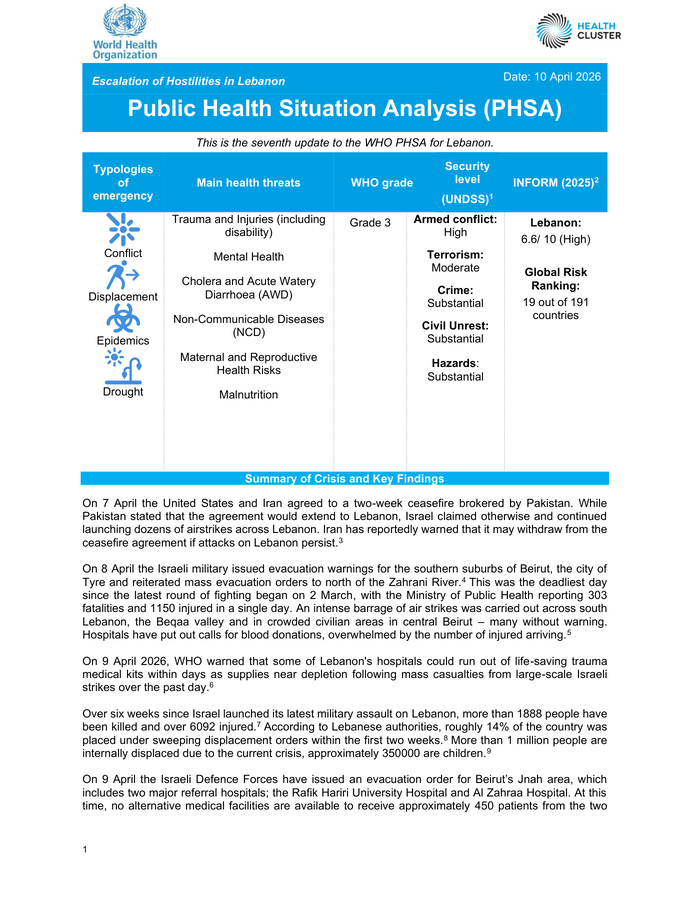
Countries: Lebanon, occupied Palestinian territory, Syrian Arab Republic Sources: Health Cluster, World Health Organization Please refer to the attached file. Summary of Crisis and Key Findings On 7 April the United States and Iran agreed to a two-week ceasefire brokered by Pakistan. While Pakistan stated that the agreement would extend to Lebanon, Israel claimed otherwise and continued launching dozens of airstrikes across Lebanon. Iran has reportedly warned that it may withdraw from the ceasefire agreement if attacks on Lebanon persist. On 8 April the Israeli military issued evacuation warnings for the southern suburbs of Beirut, the city of Tyre and reiterated mass evacuation orders to north of the Zahrani River. This was the deadliest day since the latest round of fighting began on 2 March, with the Ministry of Public Health reporting 303 fatalities and 1150 injured in a single day. An intense barrage of air strikes was carried out across south Lebanon, the Beqaa valley and in crowded civilian areas in central Beirut – many without warning. Hospitals have put out calls for blood donations, overwhelmed by the number of injured arriving. On 9 April 2026, WHO warned that some of Lebanon’s hospitals could run out of life-saving trauma medical kits within days as supplies near depletion following mass casualties from large-scale Israeli strikes over the past day. Over six weeks since Israel launched its latest military assault on Lebanon, more than 1888 people have been killed and over 6092 injured. According to Lebanese authorities, roughly 14% of the country was placed under sweeping displacement orders within the first two weeks. More than 1 million people are internally displaced due to the current crisis, approximately 350000 are children. On 9 April the Israeli Defence Forces have issued an evacuation order for Beirut’s Jnah area, which includes two major referral hospitals; the Rafik Hariri University Hospital and Al Zahraa Hospital. At this time, no alternative medical facilities are available to receive approximately 450 patients from the two hospitals (including 40 patients in the ICU), rendering their evacuation operationally unfeasible. Both facilities are operating at full capacity, including treating the injured from the strikes of 8 April. The escalation of hostilities that erupted in Lebanon in September 2024 has had catastrophic immediate effects on public health, leading to a significant loss of life, widespread injuries, and severe damage to healthcare infrastructure. The conflict had a role in severely disrupting the delivery of essential medical services.



GrowthPakistan brings you the latest news to keep an eye on Pakistan’s startup ecosystem. Business keeps you growing when you stay aware of your competitors' moves. GrowthPakistan offers Business, Tech, Global Tech, Global, Auto, and Startup News straight from industries all around the globe. This platform will help you identify upcoming opportunities not only in Pakistan but worldwide.
Email : growthpakistan@gmail.com
Whatsapp : +92320-9497079
© growthpakistan