


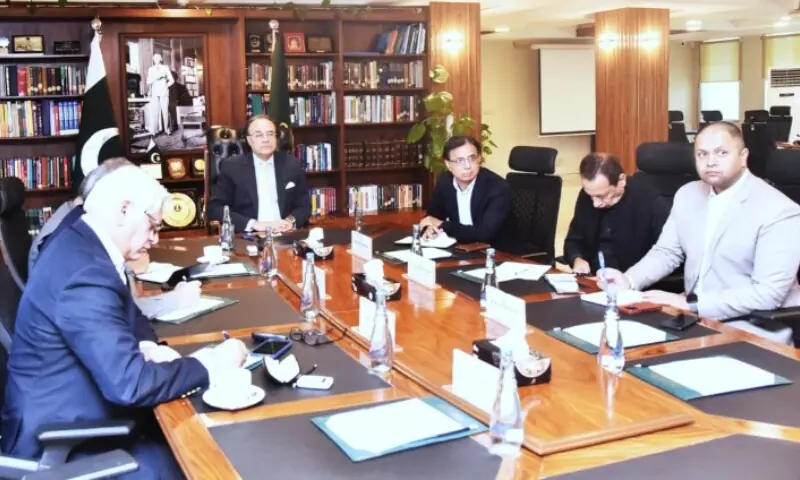
• Punjab, Sindh favour passing global oil prices to consumers • National leadership dialogue planned on March 30-31 • Petrol, diesel consumption rises amid price freeze • Targeted subsidy proposed with 20-litre monthly cap for bikers • Contingency plans include rationing, lockdowns, reduced workdays • KP opposes lockdown, warns of impact on daily wage earners ISLAMABAD: Amid provincial reluctance to shoulder the fuel subsidy burden and growing calls to pass on rising international petroleum prices to consumers, a national leadership dialogue is being arranged early next week to develop an “all-inclusive” agenda on austerity and energy conservation. Background discussions with key stakeholders suggest the provinces expressed their inability on Friday to contribute about Rs200 billion sought by the Ministry of Finance to shield consumers across the country from further hikes in petroleum prices. Both Punjab and Sindh — the two largest provinces supposed to share more than Rs102bn and about Rs60bn, respectively — instead suggested passing global prices on to the domestic market to create a price signal for behavioural change. A senior government official said a national leadership dialogue was being convened on March 30 or 31, to be attended by the president, the prime minister, the four chief ministers and their teams, to build consensus on austerity and conservation measure s and to deal with the crisis with minimal economic and social fallout. At a consultative meeting presided over by Finance Minister Muhammad Aurangzeb on petroleum products and pricing, provincial governments questioned why people should be expected to reduce fuel consumption if prices remained frozen through federal and provincial subsidies. This concern was reinforced when the Petroleum Division reported that fuel consumption in March so far had been significantly higher than in the same month last year. All four chief ministers were invited to the meeting, but only Sindh Chief Minister Murad Ali Shah attended, while other provinces were represented by ministers and secretaries. They were informed that the country was in a relatively comfortable position regarding fuel stocks and supplies until the third week of April, with additional cover secured for the April 25 to May 15 period. The Ministry of Finance informed provinces that the federal government had arranged a pool of about Rs160bn, including Rs100bn in development programme cuts and savings from austerity measures, but stressed that federal fiscal capacity had its limits. The provinces were asked to contribute Rs200bn collectively. Khyber Pakhtunkhwa and Balochistan were expected to contribute roughly Rs30bn and Rs20bn, respectively, but did not oppose the proposal outright, possibly in view of the firm stance taken by the larger provinces. The meeting also discussed a range of contingency measures to address fiscal and external account pressures in case of a prolonged Middle East crisis and worsening global conditions. These included fuel rationing, potential lockdowns, extended holidays in educational institutions, reduced working days in the private sector, similar to the public sector and implementing a 50pc work-from-home policy across both sectors. Each proposal, along with its financial implications and potential savings, was presented and deliberated. At least three provinces argued that since fuel supplies were not currently constrained, the real issue was pricing and the design of targeted subsidies. Khyber Pakhtunkhwa reportedly opposed lockdown measures, warning they would cripple economic activity and disproportionately affect daily wage earners and private sector workers. The Sindh chief minister emphasised the need to educate consumers and the public on conservation through effective pricing signals. Punjab’s secretary pointed out that the province had already spent over Rs100bn on flood relief and rehabilitation and was now being asked to contribute a similar amount towards fuel subsidies, while also maintaining a budget surplus under the IMF programme. Petroleum Minister Ali Pervaiz Malik and his team reported that diesel prices had increased by 5-6pc since last Friday, while petrol prices had declined by about 6pc. Except for Bangladesh, which is facing a run on fuel pumps, most oil-importing countries — and even some producers — have passed on higher prices to consumers. 20-litre cap Participants, however, agreed in principle to provide targeted subsidies for motorcyclists, capped at 20 litres per month, while higher-consumption users would pay market-based prices. This would be implemented through a mobile application-based quota system to ensure subsidies reach low-income groups and minimise leakages. Finance Minister Muhammad Aurangzeb, who presided over the high-level consultation, highlighted the need to promote responsible consumption behaviour and ensure policy responses remained fiscally prudent while maximising public relief. The session began with a detailed presentation by the Petroleum Division on the availability of petroleum products in the country, noting with satisfaction that supplies remained stable and adequate across the country. The Ministry of Information Technology also presented proposed technological solutions to support a targeted subsidy mechanism, focusing on transparency and efficient delivery. Provincial leadership shared their perspectives on the evolving situation. Punjab Senior Minister Marriyum Aurangzeb emphasised the need to develop multiple policy scenarios in response to changing petroleum prices. She said any reduction in international prices should be passed on to consumers. Khyber Pakhtunkhwa Finance Minister Muzzammil Aslam commended the efforts of Mr Aurangzeb and Mr Malik in managing oil supplies, noting that Pakistan’s situation remained comparatively better than several countries in the region. How app-based system works The proposed mobile application-based quota system for fuel distribution envisages a fully automated mechanism for both consumers and retail operators. According to a senior government official, a free, pre-installed application will be provided to retailers, while consumers will use a separate app. Each fuel station will be required to maintain at least two mobile devices for system operations. The Ministry of Information Technology is coordinating with mobile manufacturers to supply specialised devices, with an estimated cost of Rs36, 000 per unit and a retail price of around Rs72, 000. Petrol stations have been asked to deposit funds into a designated government account for the timely procurement of these devices. Explaining the quota mechanism, an official said vehicle-based quotas would be linked to the user’s app through the vehicle registration number and their Computerised National Identity Card (CNIC). Final quota limits, however, will be determined by the relevant cabinet committee. Users will generate a digital voucher through the app, which retailers will scan or enter into the system. The system will automatically validate the available quota — for instance, if a user requests 20 litres but has a 15-litre quota, only 15 litres will be dispensed. . Procurement of 24, 000 phones Meanwhile, the Ministry of Information Technology and Telecommunication has also invited expressions of interest (EOI) for the procurement of 24, 000 mobile phones to support the petrol subsidy app. The devices will be deployed across around 12, 000 petrol pumps, with two nozzles at each pump designated for subsidised fuel distribution. The EOI has been floated by the National Information Technology Board. An official notice stated that the initiative aims to assess indicative pricing and availability of Android smartphones before initiating formal procurement. The required devices must be brand new, PTA-approved and accompanied by a one-year official warranty along with mandatory after-sales support within Pakistan. Kalbe Ali also contributed to this report Published in Dawn, March 28th, 2026



GrowthPakistan brings you the latest news to keep an eye on Pakistan’s startup ecosystem. Business keeps you growing when you stay aware of your competitors' moves. GrowthPakistan offers Business, Tech, Global Tech, Global, Auto, and Startup News straight from industries all around the globe. This platform will help you identify upcoming opportunities not only in Pakistan but worldwide.
Email : growthpakistan@gmail.com
Whatsapp : +92320-9497079
© growthpakistan