

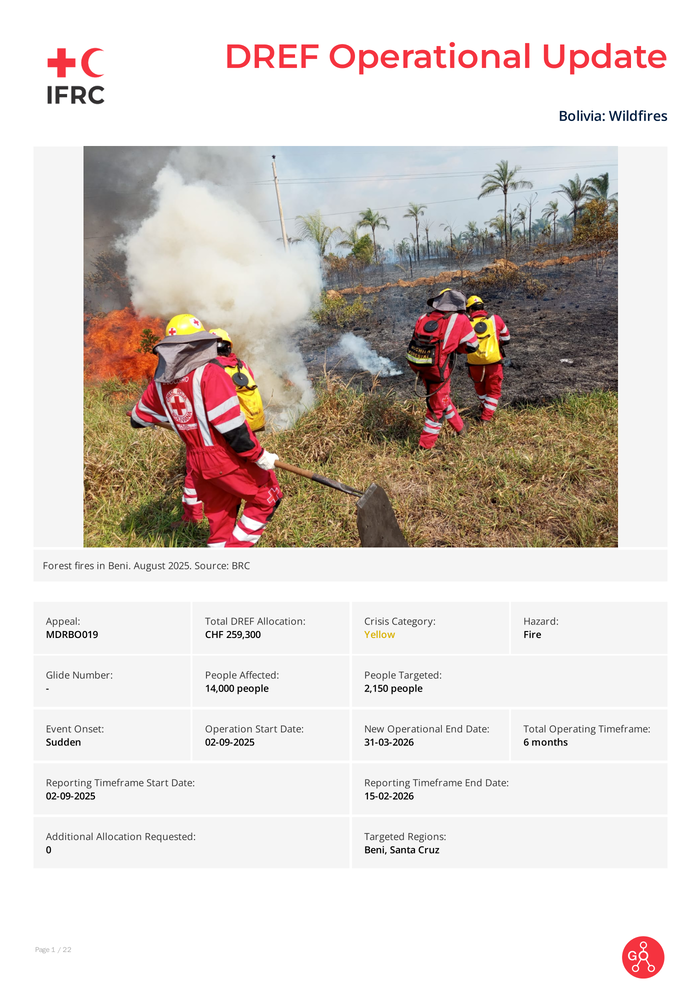
Country: Bolivia (Plurinational State of) Source: International Federation of Red Cross and Red Crescent Societies Please refer to the attached file. Description of the Event Date of event 25-08-2025 What happened, where and when? Bolivia entered its seasonal dry period between June and September, a stage characterized by a sustained increase in wildfire risk, particularly in the Amazonian and eastern regions. This risk is exacerbated by slash and burn agricultural practices used to prepare soils for planting, which, under conditions of high temperatures, lack of rainfall, strong winds, and extremely dry soils, often become uncontrolled and lead to large scale fires. Within this context, and under Supreme Decree No. 5447, the national government declared a state of emergency on 20 August 2025, identifying the departments of Santa Cruz and Beni as the most affected. Days later, on 25 August, the government convened representatives of the diplomatic corps and international organizations to request support for the response, including equipment, humanitarian assistance, and technical capacity strengthening. As of 31 August, three alerts remained active—two orange alerts and one wind alert—covering more than 160 municipalities, while 855 heat sources were reported, mainly in Santa Cruz (661) and Beni (111). Among the most severe events were the fire recorded in Noel Kempff Mercado National Park (Santa Cruz) and a large scale fire in Carrasco National Park (Cochabamba), which was brought under control after five days of coordinated operations between firefighters and local communities. This scenario unfolded in parallel with the country’s presidential electoral process, in its runoff phase, adding institutional complexity to decision making and operational coordination. By 25 September 2025, according to GWIS, Bolivia had registered 3, 713 wildfires and 1, 759, 931 hectares affected, 30% of which corresponded to protected forest areas. Santa Cruz and Beni continued to be the most impacted departments. During September, Santa Cruz declared a departmental emergency due to the combined effects of strong winds, drought, and wildfires, which affected communities, livelihoods, and ecosystems; the declaration will remain in effect until 31 December. Between 10 and 27 September, municipal COEMs were activated, red alerts were issued for 18 municipalities, and extreme temperatures of up to 44°C were recorded. By hat date, Santa Cruz reported 22 active fires and more than 127, 000 hectares affected, particularly in the Noel Kempff area. Between 500 and 600 firefighters were deployed across the department, most of them trained volunteers from the Governor’s Office and allied organizations. Meanwhile, in Guayaramerín and across the department of Beni, the national declaration sought to activate mechanisms to strengthen departmental and municipal systems. However, unlike Santa Cruz, no local declarations were issued, despite requests for assistance from communities affected by both fires and the cumulative effects of drought. Between September 2025 and February 2026, Bolivia faced a prolonged drought that worsened the situation, generating critical water shortages, contamination of water sources by ash and sediments, increases in diseases such as malaria and gastrointestinal conditions, significant losses of crops and pasturelands, fuel shortages, and logistical difficulties in accessing remote communities. These conditions, confirmed by SENAMHI and the Drought Monitor, significantly increased the social, economic, and health vulnerability of rural and Indigenous families. Within the framework of the DREF, the initial operation focused exclusively on the wildfires included in the national declaration. Between August and September, the Bolivian Red Cross (BRC), with support from the IFRC Rapid Response Operations Manager deployed to Bolivia, carried out field assessments alongside its branches in Santa Cruz, Concepción, San Ignacio de Velasco, and Guayaramerín. For the 18 February update, after completing PTM and Health activities, the operation identified drought as the predominant emerging hazard. Teams carried out visits and community dialogues in the most affected areas of the Chiquitanía—including Santa Cruz, Concepción, and San Ignacio—and in multiple rural communities of Guayaramerín, such as 18 de Junio, 2 de Octubre, Cachuela Mamoré, 27 de Noviembre, Santa Fe, 14 de Septiembre, and San Francisco. Following the presidential runoff election, assessments continued in other communities among the 19 most affected, confirming the severity of drought related impacts and the persistence of humanitarian needs.
Bolivia: Wildfires – DREF Operational Update (MDRBO019)

RELATED ARTICLES


