

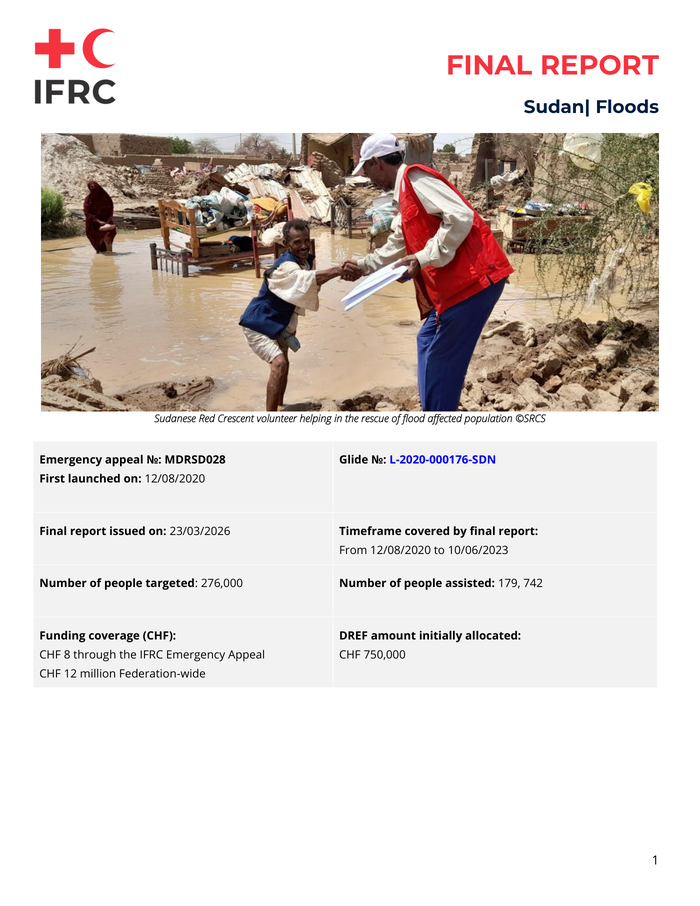
Country: Sudan Source: International Federation of Red Cross and Red Crescent Societies Please refer to the attached file. A. SITUATION ANALYSIS Description of the crisis The combination of the heavy rains, flash floods, and swollen rivers in 2020 caused widespread destruction of infrastructure, health facilities, houses, private and public buildings, and agricultural lands and affected close to 900, 000 people in 18 states nationwide. The torrential rain and flooding were the worst recorded in the country in 30 years. The most affected states included Blue Nile, Jezira, Khartoum, North Darfur, Red Sea, Sennar, and West Darfur, and accounted for most of the people affected. Many displaced persons were hosted by family members, neighbours, schools and public facilities or moved to temporary camps. Between July and October 2021, heavy rains and flooding affected an additional 92, 100 people across 12 states, according to the Humanitarian Aid Commission (HAC). More than 13, 042 homes were damaged, and over 5, 000 homes were destroyed. Most families affected by the heavy rain and flooding were forced to seek shelter with relatives and government-owned buildings. As a result of the floods, the health situation in Sudan deteriorated following the 2020 and 2021 flooding, as stagnant and contaminated water posed health risks. In many of the flooded locations, access to clean water was limited. The water supply from boreholes was affected by overflow from rivers while latrines were destroyed, thereby increasing the risk of water contamination and water-borne outbreaks. The destruction and flooding of latrines led to open defecation and water contamination. Damage to health clinics, hospitals, and latrines elevated the risk of disease outbreaks and exerted pressure on weakened health systems. Diarrhoea, malaria, and skin infections were the leading causes of mortality among children, while malaria cases were mostly reported among adults. In 2020, Sudan was confronted with Viral Haemorrhagic Fever (VHFs), polio outbreak, and Leishmaniasis (Kalazar)1 in Gedarif state. This was in addition to the annual cycles of endemic cholera, malaria, dengue, and chikungunya. Sudan continued to face the health and socio-economic consequences of COVID-19. As of 1 February 2022, 58, 208 people had tested positive for COVID-19, with 3, 442 deaths. The COVID-19 Case Fatality Rate was among the highest in the world. The decline in the economy had severely affected the provision of basic services, including health services, with only 15% of essential drugs available in the country. Impact of the Floods in 2022 In July 2022, heavy and continuous rains were experienced in several states of Sudan. Flash floods led to widespread destruction of houses and infrastructure and the displacement of thousands of people. From 9 July 2022 to the end of August 2022, the worst-hit states were; Kassala, Khartoum, River Nile, South Kordofan, South Darfur, East. Darfur, Gezira, Gedarif, Northern State, White Nile, West Kordofan, Sennar, and North Kordofan. According to the Civil Defense, Ministry of Health, and Humanitarian Aid Commission, over 100 people lost their lives as of September 2022. Thousands of acres of non-agricultural and agricultural land were submerged, including the second largest irrigation area in Sudan, Al Managil in Gezira State. As a result, it was expected to lead to food shortages, further aggravating the situation in the food-insecure Sudan. Sudan Red Crescent (SRCS) State branches reported approximately 352, 171 people (57, 117 households) were affected. An estimated 65, 346 homes were also affected (32, 216 destroyed and 33, 130 partially destroyed). 2, 683 public utilities and 10, 271 latrines were destroyed. Out of the total population affected, 96, 000 were identified as needing urgent humanitarian assistance, including basic needs, shelter materials and household kits. In addition, there was an urgent need for food, clean drinking water, health care services, first aid and psychosocial support, water, sanitation, and hygiene promotion. As of July 2022, heavy and continuous rains were experienced in several states of Sudan. Flash floods led to widespread destruction of houses and infrastructure and the displacement of thousands of people. From 09 July to the end of August 2022, floods affected the states of Kassala, Khartoum, River Nile, South Kordofan, South Darfur, East Darfur, Gezira, Gedarif, Northern State, White Nile, West Kordofan, Sennar, and North Kordofan resulting in losses of high magnitude.
Sudan: Floods – Final Report (MDRSD028)

RELATED ARTICLES


