


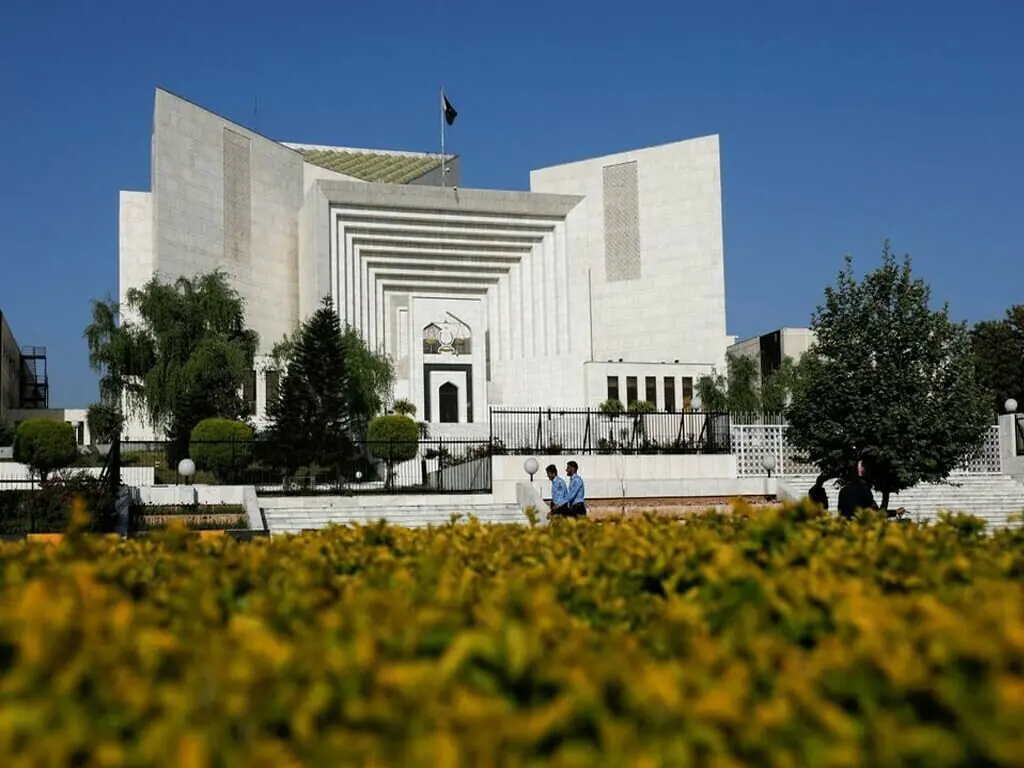
ISLAMABAD: The Supreme Court has said that in contempt cases, the accused person must be given a chance to be heard in a preliminary hearing. Upon due satisfaction that a prima facie case exists, the court can then set a date to formally frame charges against the accused in an open court. The judgment, authored by Justice Muhammad Ali Mazhar, said, “The reading of Section 17 (3) of the Contempt of Court Ordinance, 2003 clearly accentuates that before taking cognizance or fixing the date for framing of charge, the accused is to be given an opportunity of preliminary hearing by the court and after due satisfaction if prima facie case exists, the court may fix the date for framing of charge in open court and proceed to decide the matter. But in this case, the single judge appeared to have directly set the date for framing the charges without providing an opportunity to the accused for a preliminary hearing. ” The Court set aside the order dated 30. 10. 2024 passed by the single judge of the Sindh High Court (SHC) in Suit No. 918/ 2024 and the order dated 19. 11. 2024 passed by the Division Bench in HCA No. 484/ 2024 to the extent of contempt proceedings. It; however, said that the contempt application will remain pending, and if the court wants to initiate contempt proceedings, then after providing an opportunity for a preliminary hearing based on the contempt application and the counter affidavit filed by the alleged contemnor, the court may decide whether a prima facie case of contempt is made out for proceeding in accordance with law. Brief facts of the case are that the respondent No. 1 Rear Admiral Mushtaq Ahmed (retd) allegedly violated the order dated 03. 09. 2024 passed by the SHC in Suit No. 918/ 2024 in its original jurisdiction. The plaintiff No. 1, who is respondent No. 1 in this criminal appeal, moved an application for contempt of court under Article 204 of the Constitution 1973 and Sections 3 and 4 of the Ordinance, 2003. After notice, a counter affidavit was filed. The Single Judge observed that Section 17 (3) of the Ordinance requires a date to be fixed for framing of charge and also fixed the date 11. 12. 2024 for framing of charge after issuing notice to the Advocate General Sindh. Being aggrieved, the petitioner (Hira Rauf) challenged the order in High Court Appeal (HCA) No. 484/ 2024, which was disposed of on 19. 11. 2024 with a direction to the parties to appear before the single judge to further proceed in the matter. The petitioner’s counsel argued before the apex court that the single judge as well as the Divisional Bench of the High Court both misinterpreted Section 17(3) of the Ordinance, and no preliminary hearing was conducted before taking a decision or taking cognizance in contempt proceedings. The respondent’s lawyer’s stance was that the Nazir report was submitted to show some violation, based on which the court decided to take cognizance of the matter, but he admitted that no preliminary hearing was conducted. He submitted that there were some procedural lapses that occurred before the order by the single judge. The SC judgment noted there are some lapses apparent on the face of the record, and this crucial question has also been overlooked by the Division Bench while disposing of the appeal. Copyright Business Recorder, 2026



GrowthPakistan brings you the latest news to keep an eye on Pakistan’s startup ecosystem. Business keeps you growing when you stay aware of your competitors' moves. GrowthPakistan offers Business, Tech, Global Tech, Global, Auto, and Startup News straight from industries all around the globe. This platform will help you identify upcoming opportunities not only in Pakistan but worldwide.
Email : growthpakistan@gmail.com
Whatsapp : +92320-9497079
© growthpakistan