

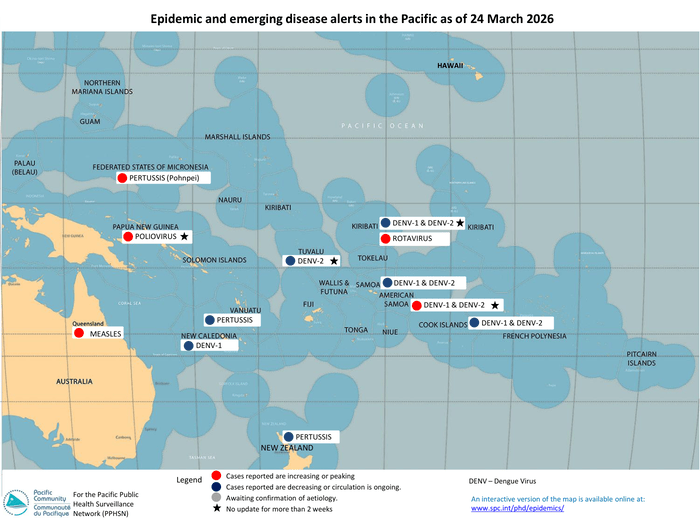
Countries: World, Australia, Fiji, Guam, Kiribati, Marshall Islands, Micronesia (Federated States of), New Caledonia (France), New Zealand, Samoa, Tokelau, Tonga, Vanuatu, Wallis and Futuna (France) Source: Pacific Community Please refer to the attached Map. Highlights/updates since the last map was sent on PacNet on 17 March 2026: Dengue New Caledonia: As of 19 March 2026, dengue activity continues in New Caledonia, with 340 cases reported since 1 January 2026, up from 268 cases reported as of 14 March 2026. Weekly case counts rose steadily from EpiWeek 07 through EpiWeek 11, indicating sustained local transmission. DENV‐1 remains the predominant circulating serotype, with transmission affecting multiple municipalities, particularly in the northern and eastern parts of the territory. The blue alert for DENV-1 remains in effect. – Sources: Vigilance DASS Dengue 2026-#4 shared with PPHSN Coordinating Body Focal point on 10 March 2026 & La dengue | Direction des Affaires Sanitaires et Sociales de Nouvelle-Calédonie accessed on 24 March 2026. Samoa: As of 15 March 2026, Samoa continues to experience a prolonged dengue outbreak, with 17, 577 cumulative clinically diagnosed cases and 5, 170 laboratory‐confirmed cases reported since 1 January 2025. During EpiWeek 11 (09–15 March 2026), 170 new dengue cases were reported, representing a 12% decrease compared with the previous week. Twelve new hospital admissions were recorded, with no ICU admissions or dengue‐related deaths during the week. DENV‐1 remains the predominant serotype (68%), while DENV‐2 accounts for 32% of confirmed cases. Transmission remains widespread across Upolu (64%) and Savaii (36%), and children under 15 years represent 74% of all cases. The cumulative number of dengue‐related deaths remains nine. The blue alert for DENV-1 and DENV-2 remains in effect. – Source: Dengue Fever Outbreak Situation Report in Samoa Issue No 48 shared with PPHSN Coordinating Body Focal point on 20 March 2026. Measles Australia: Measles activity in Australia continues in early 2026, driven primarily by imported cases with increasing evidence of local transmission. As of 19 March 2026, 33 measles cases have been confirmed in New South Wales (NSW) since 1 January, including several locally acquired cases, some with no identified source of infection, indicating ongoing community transmission across western, northern and metropolitan Sydney, as well as the Nepean Blue Mountains region. Sporadic cases have also been reported in other states and territories, including Victoria, Queensland and Western Australia, while notifications in the Australian Capital Territory, South Australia, the Northern Territory and Tasmania remain low. Public health authorities continue to emphasise early case detection, isolation, contact management and vaccination to limit further spread. The red alert for measles in Australia remains in effect. – Sources: Measles alert for western and northern Sydney, Measles alert for Nepean Blue Mountains and National Communicable Diseases Surveillance Dashboard accessed on 24 March 2026. Pertussis/Whooping cough New Zealand: Pertussis activity in New Zealand continues as part of the ongoing national epidemic, although recent weekly notifications have declined. As of the week ending 13 March 2026, 27 cases were reported, down from 40 cases the previous week, bringing the total number of cases reported in 2026 to 473. Since the start of the epidemic on 19 October 2024, 4, 205 confirmed, probable and suspected cases have been notified, with 392 cases (9. 6%) requiring hospitalisation and one death reported, while infants under one year of age remain the most affected, prompting continued emphasis on vaccination, surveillance and protection of high‐risk groups. The blue alert for pertussis remains in effect. – Sources: Pertussis dashboard & Pertussis Report 7 February–6 March 2026 accessed on 24 March 2026. Vanuatu: As of EpiWeek 10 of 2026, no new pertussis cases were reported in Vanuatu, and overall activity continues to show a declining trend compared with the peak observed in late 2025, although the outbreak remains under close monitoring. The cumulative total remains 807 pertussis cases since the outbreak was declared on 18 August 2025. This includes 777 clinically diagnosed cases and 30 laboratory‐confirmed cases. A total of 67 hospitalisations and seven pertussis‐associated deaths have been reported, including six deaths in Tanna and one in Shefa Province. Cases have been reported across all age groups, with the highest burden among children aged 1–9 years and infants under one year. Among cases with known vaccination status, 47% were unvaccinated, while 53% had received at least one dose of a pertussis‐containing vaccine. Geographically, transmission remains concentrated in Efate (~54%) and Tanna (~38%), with smaller clusters in Futuna (~8%) and one case reported from Erromango. The blue alert for pertussis remains in effect. – Source: Vanuatu Pertussis Outbreak: Situation Report 15 (16 March 2026) shared on PacNet on 20 March 2026. Rotavirus Kiribati: As of 18 March 2026, the rotavirus outbreak in Kiribati remains substantial, with 4, 854 cumulative cases reported, up from 4, 508 cases on 15 March 2026. Epidemiological trends indicate a continued decline in transmission since mid‐March, following a peak in late February to early March. Transmission remains concentrated in South Tarawa, particularly Betio, which continues to report the highest case burden. Smaller proportions of cases have been reported from North Tarawa and outer islands, including Beru. Children under five years of age remain the most affected, although cases span a wide age range. To date, 56 hospitalisations have been reported, predominantly among paediatric cases. One confirmed death and four suspected deaths remain under investigation. Health authorities continue enhanced surveillance, laboratory confirmation, health promotion and community‐level hygiene interventions, while closely monitoring for further declines or any resurgence in cases. The red alert for Rotavirus remains in effect ***. ** – Sources: Rotavirus Outbreak Situational Report 11 shared with PPHSN Coordinating Body Focal point on 18 March 2026. * Other Information: Ciguatera Vanuatu: As of 16 March 2026, ciguatera fish poisoning activity in Vanuatu remains ongoing. Two new cases were reported in EpiWeek 11, bringing the cumulative total to 63 cases. No deaths or hospitalisations were reported during this period. Case numbers declined slightly from EpiWeek 09 to EpiWeek 11 and remained below the alert threshold. Males accounted for 59% of cases, and the 15–34 year age group was the most affected. Most cases were linked to the consumption of unspecified “other” fish, with smaller numbers associated with reef fish, Karosol fish, red fish, shellfish and trevally. Cases were reported across seven islands, with Efate accounting for approximately 60% of reported cases. The surveillance team continue to closely monitor the situation. – Source: Vanuatu Ciguatera Situation Report 3 shared on PacNet on 20 March 2026. Dengue New Zealand: In New Zealand (NZ), during EpiWeek 11 (14 March – 20 March 2026), eight confirmed imported dengue cases were reported. Among confirmed cases with a travel history, 57% had returned from the Cook Islands, 29% from Samoa and 14% Indonesia. Given the known serological cross‐reactivity between dengue and other flaviviruses, some reported dengue cases may ultimately be reclassified as other flavivirus infections as epidemiological and laboratory investigations continue. – Source: NZ Arbovirus Notifications by Country (11: 14/03/2026–20/03/2026) shared with PPHSN Coordinating Body Focal point on 23 March 2026. Gastroenteritis Palau: As of 22 March 2026, gastroenteritis activity in Palau remains under close monitoring, with a recent increase in acute gastroenteritis cases observed from EpiWeek 10 although reported numbers remain below the alert threshold. During this period, 17 cases were identified, with most cases affecting adolescents aged 10–19 years, and clusters identified in Koror State, particularly in Ngerbeched and Ikelau hamlets. Norovirus is suspected as the causative agent, with investigations ongoing, and the Ministry of Health and Human Services has implemented preventive measures, including public service announcements, community awareness activities, and strengthened surveillance and reporting. – Source: Personal communication with country focal personal on 18 March 2026 and Ministry of Health & Human Services Syndromic Surveillance EpiWeek 12 shared with PPHSN Coordinating Body focal point on 23 March 2026. Leptospirosis American Samoa: As of 21 March 2026, leptospirosis activity in American Samoa has increased in early 2026, with six confirmed cases reported since January, including five cases identified in March. The outbreak has shown signs of increased severity, with two patients requiring intensive care and one fatality reported, prompting health authorities to officially declare an outbreak to facilitate resource mobilisation and strengthen clinician awareness for timely testing and treatment. The Department of Health continues to emphasise early diagnosis and antibiotic treatment, alongside public risk‐reduction measures, particularly following heavy rainfall and flooding, while aiming to raise awareness without causing undue public alarm. – Sources: DOH Press Conference – American Samoa Department of Helath – Official Facebook page & Public Health Advisory – American Samoa Department of Helath – Official Facebook page accessed on 24 March 2026. Measles Hawai’i: Measles surveillance in Hawaiʻi has been intensified following the detection of measles virus in wastewater from East Kauaʻi County, based on a sample collected on 25 February 2026 and reported on 16 March 2026. In addition, one confirmed measles case was reported on 7 March 2026 in a visitor from the continental United States, who was present on Oʻahu and Hawaiʻi Island between 26 February and 4 March. This case is not epidemiologically linked to the wastewater detection on Kauaʻi. No community transmission has been confirmed to date. The Department of Health has alerted healthcare providers statewide and continues enhanced monitoring, including wastewater surveillance. Public health messaging continues to emphasise early case identification, isolation, and vaccination, given ongoing measles activity in multiple U. S. states. – Source: DOH MONITORING WASTEWATER DETECTION OF MEASLES IN KAUAʻI COUNTY | News Releases from Department of Health accessed on 24 March 2026 Meningococcal French Polynesia: In French Polynesia, one case of invasive meningococcal disease was confirmed in EpiWeek 12 of 2026. The case involved an adult under 40 years of age from Papeete, who was hospitalised with septic shock and is clinically improving. Preventive antibiotic treatment was promptly provided to close contacts, in line with recommendations. No secondary cases have been identified to date. This is the second meningococcal case reported in 2026, and preliminary investigations indicate no link with the ongoing meningococcal outbreak in England. – Source: Bulletin de surveillance sanitaire de Polynésie française n°10 – 2026 shared with PPHSN Coordinating Body focal point on 24 March 2026. United Kingdom: the UK Health Security Agency is continuing to investigate an outbreak of invasive meningococcal disease in Kent. As of 22 March 2026, 20 laboratory‐confirmed cases have been identified, with nine additional notifications under investigation, bringing the total to 29 cases. No new cases were confirmed in the most recent update, and two deaths have been reported. The outbreak primarily affects young adults, including university students, and has prompted extensive contact tracing, preventive antibiotic administration, and a targeted MenB vaccination campaign, while the risk to the wider population remains low. – Source: https: //www. gov. uk/government/news/cases-of-invasive-meningococcal-disease-confirmed-in-kent accessed on 24 March 2026. Pertussis/Whooping cough Guam: Pertussis activity has been reported in Guam, with the Department of Public Health and Social Services confirming two additional laboratory‐confirmed cases on 18 March 2026, bringing the total number of confirmed cases in 2026 to six. Epidemiological investigation indicated that the two newly confirmed cases were linked through direct contact, and no additional clusters have been reported to date. Public health authorities continue case investigation, contact tracing, and monitoring of respiratory illness trends, while reinforcing vaccination messaging to reduce the risk of further transmission. – Sources: Guam Department of Public Health and Social Services_Official Facebook page and Guam Communicable Disease Dashboard accessed on 24 March 2026.
World: Epidemic and emerging disease alerts in the Pacific as of 24 March 2026

RELATED ARTICLES


