


Country: occupied Palestinian territory Source: UN Relief and Works Agency for Palestine Refugees in the Near East Please refer to the attached files. All information updated for 11 – 17 March 2026 [1] Days 884 – 890 since the start of the war in the Gaza Strip Highlights The Gaza Strip The Israeli authorities have expanded their militarised area within Gaza by moving the so-called “Orange Line” — a buffer area near the “Yellow Line” of Israeli control where the authorities require coordinated movements for humanitarian operations. Ten additional UNRWA installations now fall within the expanded “Orange Line”, including collective emergency shelters hosting displaced persons. All crossings into Gaza except for Kerem Shalom remain closed, despite high-level advocacy to have them opened. Only limited numbers of trucks are entering the Gaza Strip, with the consequent scarcity of goods triggering further increases in prices and leading to shortage in medicines and spare parts needed to maintain essential operations, such as lubricants for generators, and batteries. Strong winds and a sandstorm were reported across Gaza on 14 March, destroying makeshift sites and exposing displaced people to additional health risks, especially in Al Mawasi and other open areas. The site management cluster, co-led by UNRWA, collected information on incidents across the Gaza Strip to inform the humanitarian response. Key points The Gaza Strip Fatalities and injuries Between 7 October 2023 and 11 March 2026, according to the Ministry of Health (MoH), as reported by OCHA, 72, 135 Palestinians were killed in the Gaza Strip and another 171, 830 injured. UNRWA has recorded 391 colleagues killed in Gaza since the start of the war (310 UNRWA personnel, in addition to 81 persons who were supporting UNRWA [2] ), up to 17 March. Health crisis According to the MoH, as reported by WHO, 46 per cent of essential medicines and 66 per cent of medical consumables, such as surgical materials, are currently out of stock and urgently need sustained replenishment. UNRWA rapid response medical teams continue to closely monitor the trend in reported skin infections across multiple collective emergency shelters. UNRWA, together with health partners, is distributing hygiene kits in the affected locations. These measures are reportedly helping to contain the outbreak, with a continued decrease in cases of skin infections reported in recent weeks. Displacement, Site management UNRWA continues to monitor the movement of displaced persons and displacement sites. An estimated 67, 000 displaced people are living in 83 collective emergency shelters managed by the Agency. Over the winter months, UNRWA site management teams conducted approximately 6, 000 interventions, including distributing tents, tarpaulins, hygiene kits, and other non-food items to thousands of families in need and mitigating the impact of harsh weather. Currently, 127 UNRWA facilities are located within the Israeli-militarised zone behind the so-called “Yellow Line” and in areas where access is subject to Israeli approval or coordination. Operational implications and humanitarian response Around 11, 000 Palestinian UNRWA personnel continue to provide services and assistance to Gaza’s entire population in need. In the occupied West Bank, including East Jerusalem, UNRWA continues to play a central role with over 4, 000 UNRWA Palestinian personnel providing education, health, and other services to Palestine Refugees. All UNRWA international staff are prevented from entering the Occupied Palestinian Territory – the Gaza Strip and the West Bank, including East Jerusalem. This follows the implementation of laws passed by the Israeli parliament on 28 October 2024 [3] that purport to prohibit UNRWA’s operations in areas that Israel considers its sovereign territory, including occupied East Jerusalem, and seek to bar any contact by Israeli officials with UNRWA. The Israeli authorities have not granted the Agency’s international staff visas or permits to enter the Occupied Palestinian Territory, including Gaza, since the end of January 2025. Since March 2025, the Israeli authorities have been blocking UNRWA from directly bringing humanitarian personnel and aid into the Gaza Strip. Meanwhile, pre-positioned outside Gaza, UNRWA has enough food parcels, flour, and shelter supplies for hundreds of thousands of people. The occupied West Bank, including East Jerusalem According to OCHA, between 7 October 2023 and 15 March 2026, 1, 071 Palestinians – at least 233 of them children – were killed in the occupied West Bank, including East Jerusalem. Of these, 25 have been killed since the beginning of 2026. Israeli settlers shot dead a Palestinian in the town of Qusra, in Nablus governorate, on 14 March. At least two other residents were also injured. The death marked the latest in a surge of fatalities associated with settler violence, with seven Palestinians killed in such incidents since the regional escalation began on 28 February. Early on 15 March, Israeli forces opened fire on a vehicle, killing a Palestinian family of four, including two children, in Tammun in the northern West Bank. Two further children from the family were injured. The following day was declared a day of mourning by the Tammun municipality. Missile fragments and interceptor shrapnel linked to the regional escalation continued to be reported across the West Bank, particularly in the central governorates. On 16 March, missile fragments landed in the vicinity of several holy sites in Jerusalem, including the Al Aqsa Mosque compound and the Church of the Holy Sepulchre.



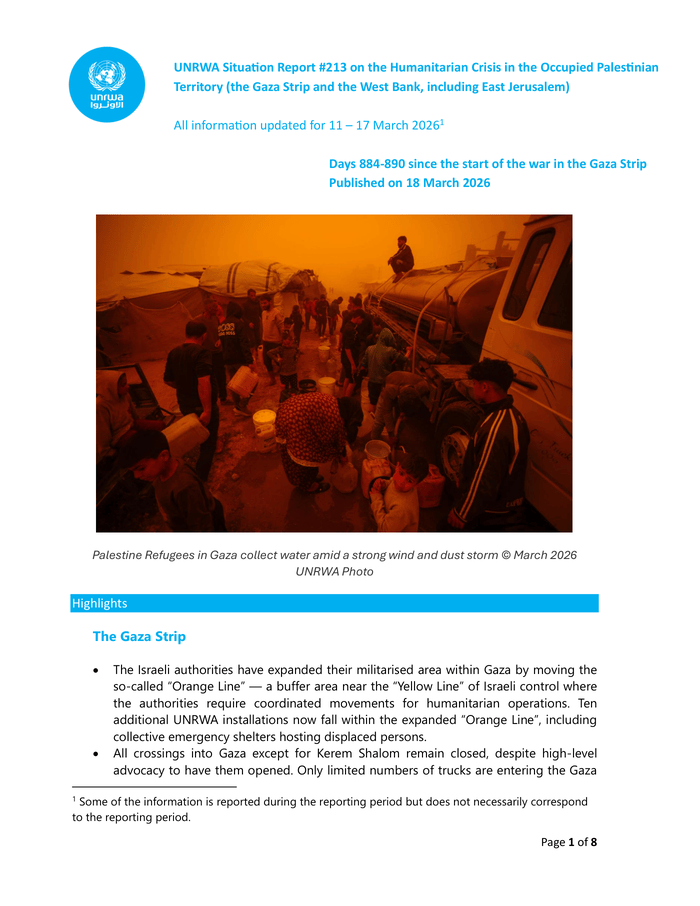
GrowthPakistan brings you the latest news to keep an eye on Pakistan’s startup ecosystem. Business keeps you growing when you stay aware of your competitors' moves. GrowthPakistan offers Business, Tech, Global Tech, Global, Auto, and Startup News straight from industries all around the globe. This platform will help you identify upcoming opportunities not only in Pakistan but worldwide.
Email : growthpakistan@gmail.com
Whatsapp : +92320-9497079
© growthpakistan