


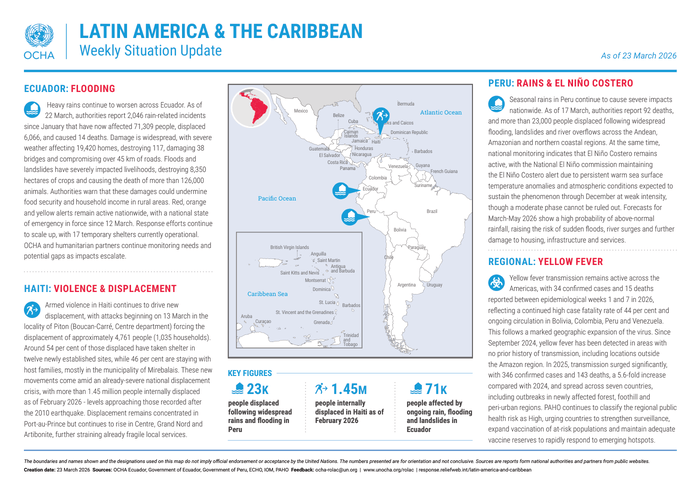
Countries: Ecuador, Bolivia (Plurinational State of), Colombia, Haiti, Peru, Venezuela (Bolivarian Republic of) Source: UN Office for the Coordination of Humanitarian Affairs Please refer to the attached file. KEY FIGURES 23K people displaced following widespread rains and flooding in Peru 1. 45M people internally displaced in Haiti as of February 2026 71K people affected by ongoing rain, flooding and landslides in Ecuador ECUADOR: FLOODING Heavy rains continue to worsen across Ecuador. As of 22 March, authorities report 2, 046 rain‐related incidents since January that have now affected 71, 309 people, displaced 6, 066, and caused 14 deaths. Damage is widespread, with severe weather affecting 19, 420 homes, destroying 117, damaging 38 bridges and compromising over 45 km of roads. Floods and landslides have severely impacted livelihoods, destroying 8, 350 hectares of crops and causing the death of more than 126, 000 animals. Authorities warn that these damages could undermine food security and household income in rural areas. Red, orange and yellow alerts remain active nationwide, with a national state of emergency in force since 12 March. Response efforts continue to scale up, with 17 temporary shelters currently operational. OCHA and humanitarian partners continue monitoring needs and potential gaps as impacts escalate. HAITI: VIOLENCE & DISPLACEMENT Armed violence in Haiti continues to drive new displacement, with attacks beginning on 13 March in the locality of Piton (Boucan‐Carré, Centre department) forcing the displacement of approximately 4, 761 people (1, 035 households). Around 54 per cent of those displaced have taken shelter in twelve newly established sites, while 46 per cent are staying with host families, mostly in the municipality of Mirebalais. These new movements come amid an already‐severe national displacement crisis, with more than 1. 45 million people internally displaced as of February 2026 – levels approaching those recorded after the 2010 earthquake. Displacement remains concentrated in Port‐au‐Prince but continues to rise in Centre, Grand Nord and Artibonite, further straining already fragile local services. PERU: RAINS & EL NIÑO COSTERO Seasonal rains in Peru continue to cause severe impacts nationwide. As of 17 March, authorities report 92 deaths, and more than 23, 000 people displaced following widespread flooding, landslides and river overflows across the Andean, Amazonian and northern coastal regions. At the same time, national monitoring indicates that El Niño Costero remains active, with the National El Niño commission maintaining the El Niño Costero alert due to persistent warm sea surface temperature anomalies and atmospheric conditions expected to sustain the phenomenon through December at weak intensity, though a moderate phase cannot be ruled out. Forecasts for March-May 2026 show a high probability of above‐normal rainfall, raising the risk of sudden floods, river surges and further damage to housing, infrastructure and services. REGIONAL: YELLOW FEVER Yellow fever transmission remains active across the Americas, with 34 confirmed cases and 15 deaths reported between epidemiological weeks 1 and 7 in 2026, reflecting a continued high case fatality rate of 44 per cent and ongoing circulation in Bolivia, Colombia, Peru and Venezuela. This follows a marked geographic expansion of the virus. Since September 2024, yellow fever has been detected in areas with no prior history of transmission, including locations outside the Amazon region. In 2025, transmission surged significantly, with 346 confirmed cases and 143 deaths, a 5. 6‐fold increase compared with 2024, and spread across seven countries, including outbreaks in newly affected forest, foothill and peri‐urban regions. PAHO continues to classify the regional public health risk as High, urging countries to strengthen surveillance, expand vaccination of at‐risk populations and maintain adequate vaccine reserves to rapidly respond to emerging hotspots.



GrowthPakistan brings you the latest news to keep an eye on Pakistan’s startup ecosystem. Business keeps you growing when you stay aware of your competitors' moves. GrowthPakistan offers Business, Tech, Global Tech, Global, Auto, and Startup News straight from industries all around the globe. This platform will help you identify upcoming opportunities not only in Pakistan but worldwide.
Email : growthpakistan@gmail.com
Whatsapp : +92320-9497079
© growthpakistan