


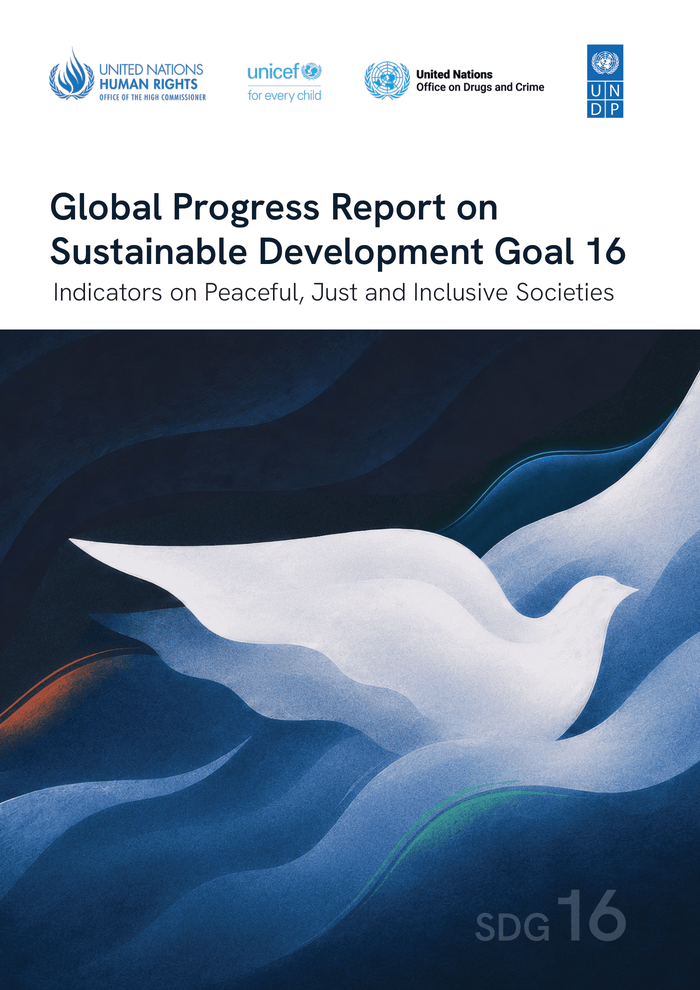
Country: World Sources: UN Children’s Fund, UN Development Programme, UN Office of the High Commissioner for Human Rights, UN Office on Drugs and Crime Please refer to the attached file. Peace, Justice, Inclusion A global look at where the world stands on building peaceful, just, and inclusive societies — and how far there is left to go. Foreword More than a decade after Member States adopted the 2030 Agenda, the conditions for sustainable development have changed profoundly. Humanity possesses greater technological, scientific and economic capabilities than at any point in history. Yet growing insecurity, deepening polarization and declining trust, alongside violent conflicts, economic uncertainty and geopolitical fragmentation, are making hard-won development gains increasingly fragile. In this context, the challenge of our time is not only identifying solutions but ensuring that institutions are capable and resilient enough to turn those solutions into life-changing results. This report examines global progress towards Sustainable Development Goal (SDG) 16. The evidence presented here reminds us that Goal 16 is not simply one of 17 goals. Peace, justice and inclusive institutions are the foundations on which progress across the entire 2030 Agenda depends. Drawing on the latest global evidence, the report presents a mixed picture of progress. Important gains have been achieved in several areas, from expanding legal identity and women’s representation in public institutions to the establishment of independent human rights institutions and access to information laws. Yet progress remains uneven. Large shares of the population continue to experience violence and discrimination, barriers to justice persist, and progress across several indicators has stalled or remains too slow to meet the ambitions of the 2030 Agenda. The findings of this report point to a clear lesson: lasting progress depends on sustained political commitment, long-term investment, strong partnerships and institutions that earn and maintain public trust. They also reinforce the importance of prevention. Investing early in children, women, and those at risk of being left behind, while strengthening justice systems, human rights protection, accountable governance, public integrity and effective public services is far less costly — and far more effective — than responding after violence, conflict, corruption or exclusion have already taken hold. As we enter the final years of the 2030 Agenda, the message is both urgent and hopeful. Progress is possible. But it does not happen by itself. It requires deliberate choices and sustained effort. The vision of the SDGs is clear: a world where peace, justice, and strong institutions are not privileges enjoyed by some. They are the foundations of a future that works for all. Volker Türk High Commissioner for Human Rights OHCHR Alexander De Croo Administrator UNDP Catherine Russell Executive Director UNICEF Monica Juma Executive Director UNODC



GrowthPakistan brings you the latest news to keep an eye on Pakistan’s startup ecosystem. Business keeps you growing when you stay aware of your competitors' moves. GrowthPakistan offers Business, Tech, Global Tech, Global, Auto, and Startup News straight from industries all around the globe. This platform will help you identify upcoming opportunities not only in Pakistan but worldwide.
Email : growthpakistan@gmail.com
Whatsapp : +92320-9497079
© growthpakistan