


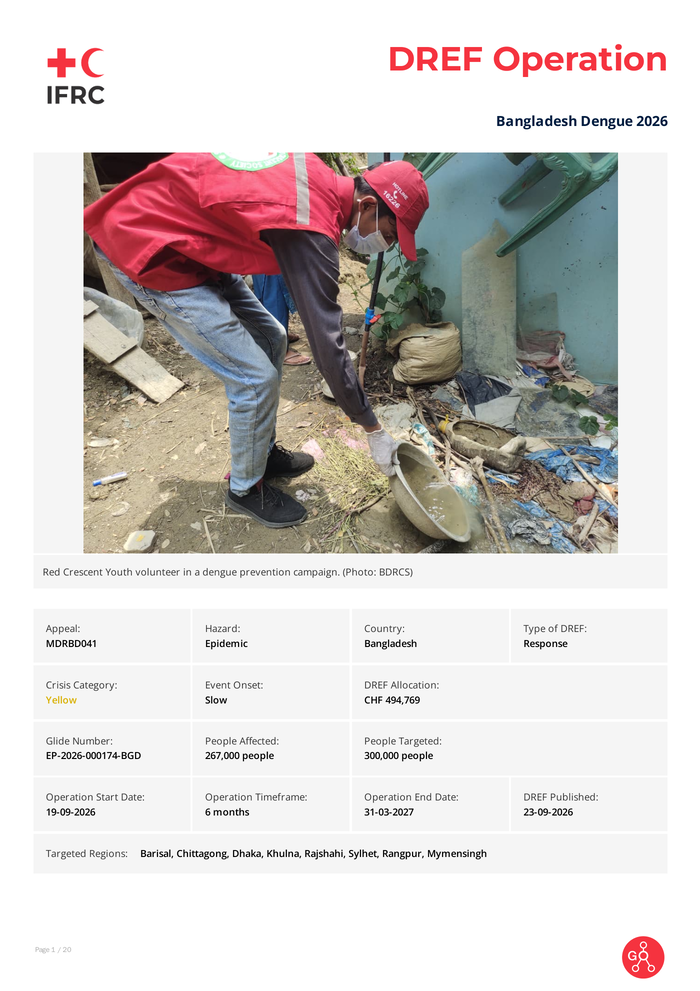
Country: Bangladesh Source: International Federation of Red Cross and Red Crescent Societies Please refer to the attached file. Description of the Event Date when the trigger was met 14-09-2026 What happened, where and when? Dengue continues to be a major public health challenge in Bangladesh. Every year, seasonal outbreaks put many lives at risk and place extra pressure on the healthcare system. Bangladesh is facing an escalating dengue outbreak in 2026, with cases rising sharply since late August following heavy monsoon rains according to the Directorate General of Health Services (DGHS). Until mid-August 2026, the number of dengue cases was lower than during the same period in 2025. However, heavy monsoon rains in late August led to a rapid increase in infections. As a result, the total number of cases quickly surpassed the figure recorded during the same period last year. According to DGHS, In September 2026, more than 15, 000 new dengue cases and 52 deaths have been reported up to 13 September. Between 8 and 13 September 2026, more than 8, 000 new dengue cases were reported, with 16 deaths recorded during this six-day period. During the first 13 days of September, the country recorded an average of more than 1, 200 hospital admissions per day, indicating a continued sharp increase in dengue transmission and the pressure on health facilities. August recorded 20, 536 hospital admissions and 43 deaths; more than double the 9, 206 admissions recorded in July 2026. Moreover, according to some popular news portals, hospitals are currently managing a dual caseload of measles and dengue admissions, placing additional pressure on an already stretched health system. Health authorities report that measles patients require strict isolation owing to the disease’s high transmissibility and cannot be co-located with dengue admissions. This is constraining ward capacity and complicating patient triage and management across affected facilities. A further rise in dengue cases is expected to compound this pressure. Health experts anticipate a sharp increase in dengue infections over the coming two months, driven by continued wet weather conditions and gaps in vector control coverage. The current surge has affected all eight divisions, with Dhaka Division the hardest hit. From 1 January to 13 September 2026, Dhaka Division (including its two city corporations) reported 20, 177 cases approximately 40% of the national total. Khulna (8, 096), Chattogram (7, 391) and Barishal (7, 313) reported the next-highest numbers, followed by Rajshahi (2, 915) and Mymensingh (2, 788). Sylhet and Rangpur reported the lowest numbers. Camps in Cox’s Bazar: By Epidemiological Week 35 (30 August–5 September 2026), 2, 698 dengue cases had been reported across the 33 Rohingya camps in Cox’s Bazar. During EW35, 135 RDT-positive cases were identified, including 116 (86%) among the Rohingya population and 19 (14%) among the host community. Although this represented a 37 per cent decrease from the previous week (214 cases), the outbreak continues to pose significant public health concern in the camps. In 2026, 10 dengue-related deaths have been reported, resulting in case fatality rate (CFR) of 0. 42 per cent, with six deaths occurring among children under 10 years of age. Overall, the dengue cases are lower during January–August 2026 in comparison to the same period of 2025. A total of 1, 496 cases were recorded during January–August 2026 compared with 2, 963 during January–August 2025. In response to the escalating dengue outbreak, the Bangladesh Red Crescent Society (BDRCS) activated its volunteer network to support community awareness, health promotion, and clean-up activities in affected areas. As the outbreak continued to intensify and critical gaps emerged in diagnostics, case management, blood services, and community-level prevention. BDRCS requested support from the IFRC through the Disaster Response Emergency Fund (DREF) to scale up its response. Throughout the outbreak, BDRCS has been maintaining close coordination with the Directorate General of Health Services (DGHS), IFRC, and in-country Participating National Societies (PNSs) to monitor the situation and identify priority needs. Following ongoing technical discussions, DGHS formally requested support from BDRCS on 16 September 2026 for critical dengue response commodities and community awareness materials, reinforcing the need for additional surge capacity to address the growing humanitarian impact of the outbreak.



GrowthPakistan brings you the latest news to keep an eye on Pakistan’s startup ecosystem. Business keeps you growing when you stay aware of your competitors' moves. GrowthPakistan offers Business, Tech, Global Tech, Global, Auto, and Startup News straight from industries all around the globe. This platform will help you identify upcoming opportunities not only in Pakistan but worldwide.
Email : growthpakistan@gmail.com
Whatsapp : +92320-9497079
© growthpakistan