

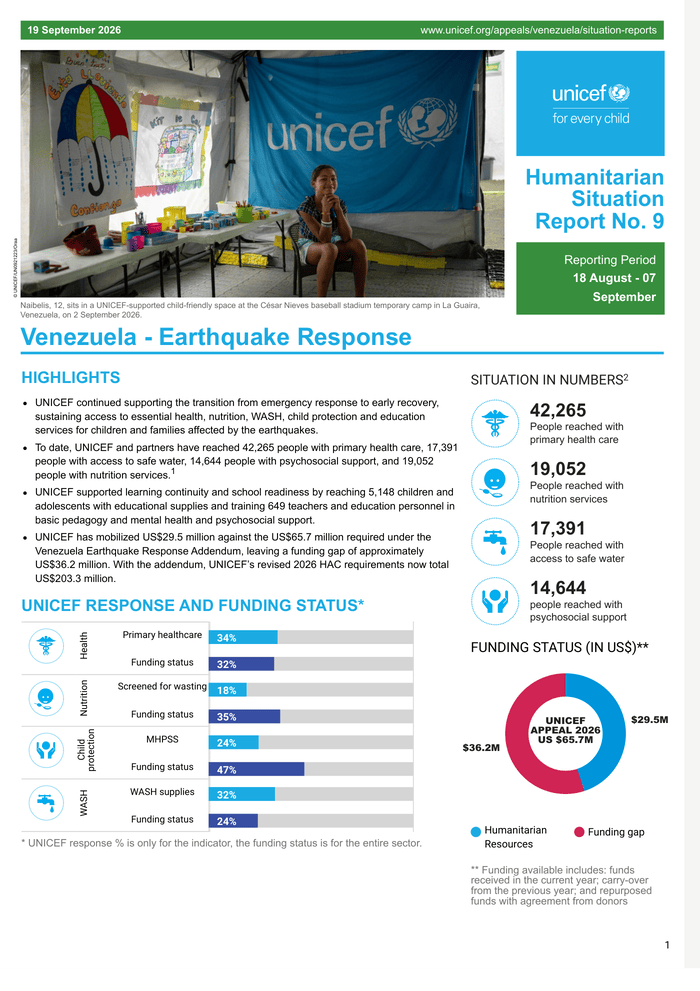
Country: Venezuela (Bolivarian Republic of) Source: UN Children’s Fund Please refer to the attached file. Highlights UNICEF continued supporting the transition from emergency response to early recovery, sustaining access to essential health, nutrition, WASH, child protection and education services for children and families affected by the earthquakes. To date, UNICEF and partners have reached 42, 265 people with primary health care, 17, 391 people with access to safe water, 14, 644 people with psychosocial support, and 19, 052 people with nutrition services. UNICEF supported learning continuity and school readiness by reaching 5, 148 children and adolescents with educational supplies and training 649 teachers and education personnel in basic pedagogy and mental health and psychosocial support. UNICEF has mobilized US$29. 5 million against the US$65. 7 million required under the Venezuela Earthquake Response Addendum, leaving a funding gap of approximately US$36. 2 million. With the addendum, UNICEF’s revised 2026 HAC requirements now total US$203. 3 million. SITUATION OVERVIEW AND HUMANITARIAN NEEDS As response efforts increasingly transition towards early recovery, humanitarian needs remain significant in earthquake-affected communities. According to the International Organization for Migration (IOM), 3 authorities have assessed 60, 785 structures to date. Of these, 35, 545 have been declared safe for occupancy, 14, 239 are subject to usage restrictions, and 11, 001 have been classified as high risk. Authorities also report that 335 housing units have been provided to families whose homes were destroyed. Debris clearance operations have removed a cumulative 600, 790. 7 metric tons of rubble, representing 28. 6 per cent of the estimated total. Official information further indicates that 107 temporary camps remain operational, with a capacity to accommodate 25, 212 people. As of the latest reporting, 23, 901 individuals continue to reside on these sites. Rising temperatures have increased water consumption, creating additional challenges in maintaining adequate access to safe water. Health services continue to face constraints related to human resources, medical supplies, cold-chain equipment and funding required to expand coverage in hard-to-reach communities. Population movements between temporary camps, host communities and other accommodation arrangements continue to affect follow-up for pregnant and breastfeeding women, as well as the identification and continuity of care for children and adolescents exposed to protection risks. The continued use of some schools as temporary camps, together with shared-school arrangements hosting students from multiple institutions, is placing additional pressure on education infrastructure and delaying the return of some children to the classroom. Humanitarian and government partners are increasingly focused on sustaining the transition from emergency response to early recovery, including the movement of families from temporary camps towards alternative accommodation and community-based solutions. UNICEF, in coordination with national and local authorities, is supporting the rehabilitation of damaged water supply systems to help restore safe and reliable access to drinking water for affected populations. Interventions include repairs to water infrastructure, rehabilitation of pumping stations and distribution networks, water quality monitoring, and the provision of technical assistance to local service providers. These efforts aim to reduce reliance on emergency water trucking while strengthening the resilience and functionality of community water systems as families move from temporary camps to more sustainable accommodation solutions. Coordination efforts also continue to support the safe return of children and adolescents to school and the restoration of essential services. Priorities remain centred on maintaining access to health, nutrition, WASH, child protection and education services for the most vulnerable, while strengthening national systems and community-based mechanisms to support continuity of services and recovery.
UNICEF Venezuela Situation Report No. 9 (Earthquake Response), 18 August – 7 September 2026

RELATED ARTICLES


