


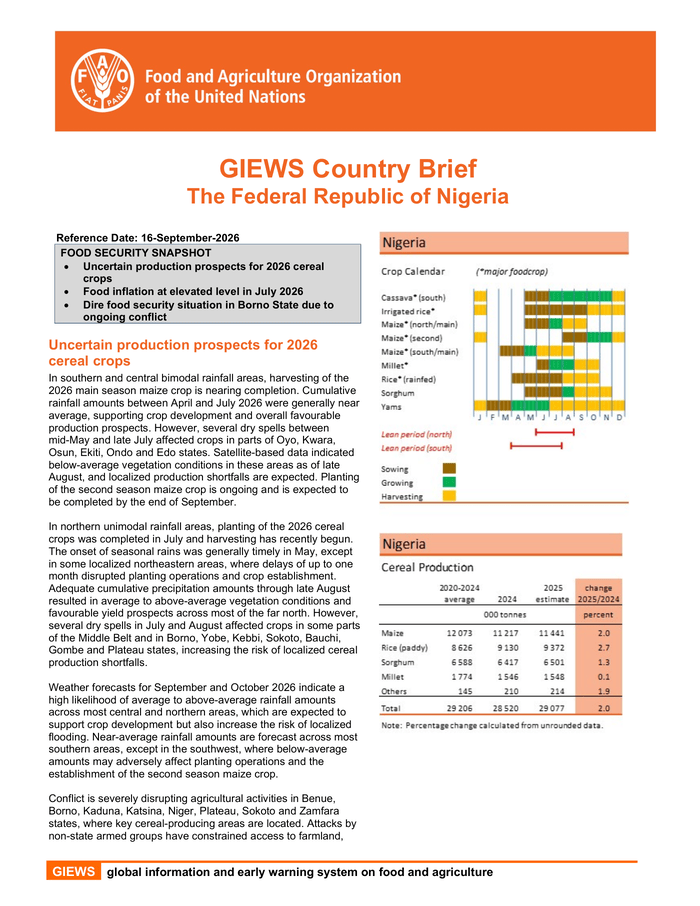
Country: Nigeria Source: Food and Agriculture Organization of the United Nations Please refer to the attached file. OOD SECURITY SNAPSHOT Uncertain production prospects for 2026 cereal crops Food inflation at elevated level in July 2026 Dire food security situation in Borno State due to ongoing conflict Uncertain production prospects for 2026 cereal crops In southern and central bimodal rainfall areas, harvesting of the 2026 main season maize crop is nearing completion. Cumulative rainfall amounts between April and July 2026 were generally near average, supporting crop development and overall favourable production prospects. However, several dry spells between mid‐May and late July affected crops in parts of Oyo, Kwara, Osun, Ekiti, Ondo and Edo states. Satellite‐based data indicated below‐average vegetation conditions in these areas as of late August, and localized production shortfalls are expected. Planting of the second season maize crop is ongoing and is expected to be completed by the end of September. In northern unimodal rainfall areas, planting of the 2026 cereal crops was completed in July and harvesting has recently begun. The onset of seasonal rains was generally timely in May, except in some localized northeastern areas, where delays of up to one month disrupted planting operations and crop establishment. Adequate cumulative precipitation amounts through late August resulted in average to above-average vegetation conditions and favourable yield prospects across most of the far north. However, several dry spells in July and August affected crops in some parts of the Middle Belt and in Borno, Yobe, Kebbi, Sokoto, Bauchi, Gombe and Plateau states, increasing the risk of localized cereal production shortfalls. Weather forecasts for September and October 2026 indicate a high likelihood of average to above‐average rainfall amounts across most central and northern areas, which are expected to support crop development but also increase the risk of localized flooding. Near‐average rainfall amounts are forecast across most southern areas, except in the southwest, where below-average amounts may adversely affect planting operations and the establishment of the second season maize crop. Conflict is severely disrupting agricultural activities in Benue, Borno, Kaduna, Katsina, Niger, Plateau, Sokoto and Zamfara states, where key cereal‐producing areas are located. Attacks by non-state armed groups have constrained access to farmland, while their imposition of levies and cultivation bans has forced some farming households to reduce the area planted or suspend agricultural activities, with production shortfalls expected in affected areas. High agricultural input prices are expected to constrain cereal production in 2026. Rising fuel prices have increased transportation and production costs, while sharp increases in fertilizer prices, estimated at 12 percent for NPK and 43 percent for urea between February and May 2026, have likely curtailed fertilizer application rates, with negative effects on yields. Food inflation at elevated level in July 2026 The annual food inflation rate increased for the sixth consecutive month in July 2026, reaching 20. 3 percent, up from 8. 9 percent in January 2026, but remaining below the 26. 2 percent recorded a year earlier. Sharp increases in domestic petrol prices during the first half of 2026 have raised transportation costs, while reduced market supply and strong household demand exerted further upward pressure on food prices. Dire food security situation in Borno State due to ongoing conflict According to the latest available Cadre Harmonisé (CH) analysis, nearly 36. 3 million people (17 percent of the analysed population) were estimated to face severe acute food insecurity (CH Phase 3 [Crisis] and above) during the June to August 2026 lean season, including about 2. 1 million people in CH Phase 4 (Emergency) and approximately 10 300 people in CH Phase 5 (Catastrophe). This represents a deterioration compared to the corresponding period in 2025, when more than 30. 6 million people (15 percent of the analysed population) were estimated to be in CH Phase 3 and above, mainly reflecting the effects of escalating conflict and ongoing economic challenges. High levels of violence were reported between January and August 2026, particularly in the North‐East, North‐Central and North‐West zones, where livelihoods and market activities were severely disrupted. As of early August 2026, over 3. 7 million people were internally displaced nationwide, with about two‐thirds located in Borno State, where humanitarian needs are particularly high and some populations were estimated to have faced CH Phase 5 (Catastrophe) conditions during the 2026 lean season. Movement restrictions in Abadam, Bama, Guzamala and Marte Local Government Areas (LGAs) continue to impede access to farmland, grazing areas and markets and also hamper the delivery of humanitarian assistance, thereby severely constraining food availability and access. The ongoing cholera outbreak in Borno State has further exacerbated humanitarian needs among affected households. Income‐earning opportunities remain limited, reflecting reduced demand for agricultural labour amid high input costs and conflict‐related disruptions, as well as increased competition for available jobs. Although daily wage rates have reportedly remained near their year‐earlier levels, sustained inflationary pressures have eroded the purchasing power of poor households across the country, constraining their access to food.



GrowthPakistan brings you the latest news to keep an eye on Pakistan’s startup ecosystem. Business keeps you growing when you stay aware of your competitors' moves. GrowthPakistan offers Business, Tech, Global Tech, Global, Auto, and Startup News straight from industries all around the globe. This platform will help you identify upcoming opportunities not only in Pakistan but worldwide.
Email : growthpakistan@gmail.com
Whatsapp : +92320-9497079
© growthpakistan