


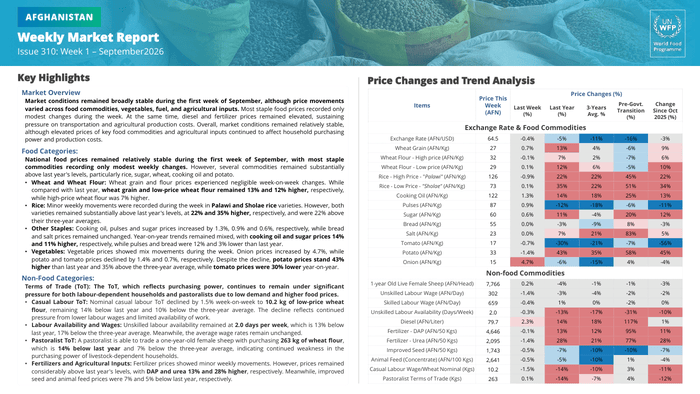
Country: Afghanistan Source: World Food Programme Please refer to the attached file. Key Highlights Market Overview Market conditions remained broadly stable during the first week of September, although price movements varied across food commodities, vegetables, fuel, and agricultural inputs. Most staple food prices recorded only modest changes during the week. At the same time, diesel and fertilizer prices remained elevated, sustaining pressure on transportation and agricultural production costs. Overall, market conditions remained relatively stable, although elevated prices of key food commodities and agricultural inputs continued to affect household purchasing power and production costs. Food Categories: National food prices remained relatively stable during the first week of September, with most staple commodities recording only modest weekly changes. However, several commodities remained substantially above last year’s levels, particularly rice, sugar, wheat, cooking oil and potato. • Wheat and Wheat Flour: Wheat grain and flour prices experienced negligible week-on-week changes. While compared with last year, wheat grain and low-price wheat flour remained 13% and 12% higher, respectively, while high-price wheat flour was 7% higher. • Rice: Minor weekly movements were recorded during the week in Palawi and Sholae rice varieties. However, both varieties remained substantially above last year’s levels, at 22% and 35% higher, respectively, and were 22% above their three-year averages. • Other Staples: Cooking oil, pulses and sugar prices increased by 1. 3%, 0. 9% and 0. 6%, respectively, while bread and salt prices remained unchanged. Year-on-year trends remained mixed, with cooking oil and sugar prices 14% and 11% higher, respectively, while pulses and bread were 12% and 3% lower than last year. • Vegetables: Vegetable prices showed mix movements during the week. Onion prices increased by 4. 7%, while potato and tomato prices declined by 1. 4% and 0. 7%, respectively. Despite the decline, potato prices stand 43% higher than last year and 35% above the three-year average, while tomato prices were 30% lower year-on-year. Non-Food Categories: Terms of Trade (ToT): The ToT, which reflects purchasing power, continues to remain under significant pressure for both labour-dependent households and pastoralists due to low demand and higher food prices. • Casual Labour ToT: Nominal casual labour ToT declined by 1. 5% week-on-week to 10. 2 kg of low-price wheat flour, remaining 14% below last year and 10% below the three-year average. The decline reflects continued pressure from lower labour wages and limited availability of work. • Labour Availability and Wages: Unskilled labour availability remained at 2. 0 days per week, which is 13% below last year, 17% below the three-year average. Meanwhile, the average wage rates remain unchanged. • Pastoralist ToT: A pastoralist is able to trade a one-year-old female sheep with purchasing 263 kg of wheat flour, which is 14% below last year and 7% below the three-year average, indicating continued weakness in the purchasing power of livestock-dependent households. • Fertilizers and Agricultural Inputs: Fertilizer prices showed minor weekly movements. However, prices remained considerably above last year’s levels, with DAP and urea 13% and 28% higher, respectively. Meanwhile, improved seed and animal feed prices were 7% and 5% below last year, respectively.



GrowthPakistan brings you the latest news to keep an eye on Pakistan’s startup ecosystem. Business keeps you growing when you stay aware of your competitors' moves. GrowthPakistan offers Business, Tech, Global Tech, Global, Auto, and Startup News straight from industries all around the globe. This platform will help you identify upcoming opportunities not only in Pakistan but worldwide.
Email : growthpakistan@gmail.com
Whatsapp : +92320-9497079
© growthpakistan