


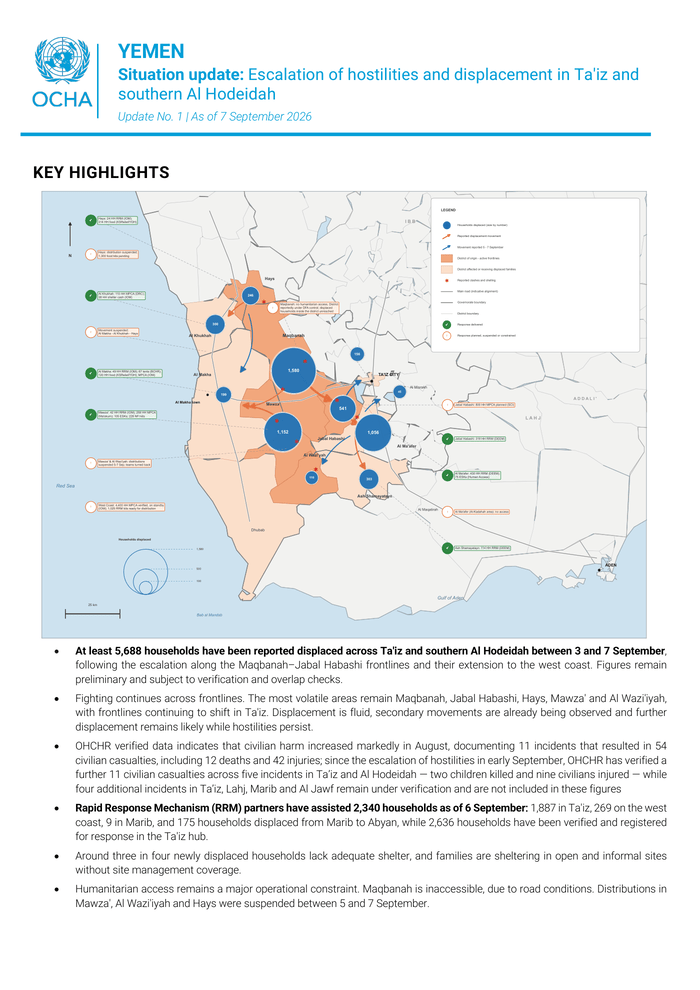
Country: Yemen Source: UN Office for the Coordination of Humanitarian Affairs Please refer to the attached file. KEY HIGHLIGHTS At least 5, 688 households have been reported displaced across Ta’iz and southern Al Hodeidah between 3 and 7 September, following the escalation along the Maqbanah–Jabal Habashi frontlines and their extension to the west coast. Figures remain preliminary and subject to verification and overlap checks. Fighting continues across frontlines. The most volatile areas remain Maqbanah, Jabal Habashi, Hays, Mawza’ and Al Wazi’iyah, with frontlines continuing to shift in Ta’iz. Displacement is fluid, secondary movements are already being observed and further displacement remains likely while hostilities persist. OHCHR verified data indicates that civilian harm increased markedly in August, documenting 11 incidents that resulted in 54 civilian casualties, including 12 deaths and 42 injuries; since the escalation of hostilities in early September, OHCHR has verified a further 11 civilian casualties across five incidents in Ta’iz and Al Hodeidah — two children killed and nine civilians injured — while four additional incidents in Ta’iz, Lahj, Marib and Al Jawf remain under verification and are not included in these figures. Rapid Response Mechanism (RRM) partners have assisted 2, 340 households as of 6 September: 1, 887 in Ta’iz, 269 on the west coast, 9 in Marib, and 175 households displaced from Marib to Abyan, while 2, 636 households have been verified and registered for response in the Ta’iz hub. Around three in four newly displaced households lack adequate shelter, and families are sheltering in open and informal sites without site management coverage. Humanitarian access remains a major operational constraint. Maqbanah is inaccessible, due to road conditions. Distributions in Mawza’, Al Wazi’iyah and Hays were suspended between 5 and 7 September. Stocks need replenishment to support an urgent scale-up. Shelter/non-food items (NFIs) partners report a combined funding gap of some US$3. 0 million with no contingency stock, the RRM requires US$7. 07 million to bridge urgent gaps, and 1, 087 households — around 23 per cent of the identified emergency food caseload — have no confirmed response. Al Makha seaport has sustained significant damage and activities are suspended, with implications for markets and supply that have yet to be assessed.



GrowthPakistan brings you the latest news to keep an eye on Pakistan’s startup ecosystem. Business keeps you growing when you stay aware of your competitors' moves. GrowthPakistan offers Business, Tech, Global Tech, Global, Auto, and Startup News straight from industries all around the globe. This platform will help you identify upcoming opportunities not only in Pakistan but worldwide.
Email : growthpakistan@gmail.com
Whatsapp : +92320-9497079
© growthpakistan