

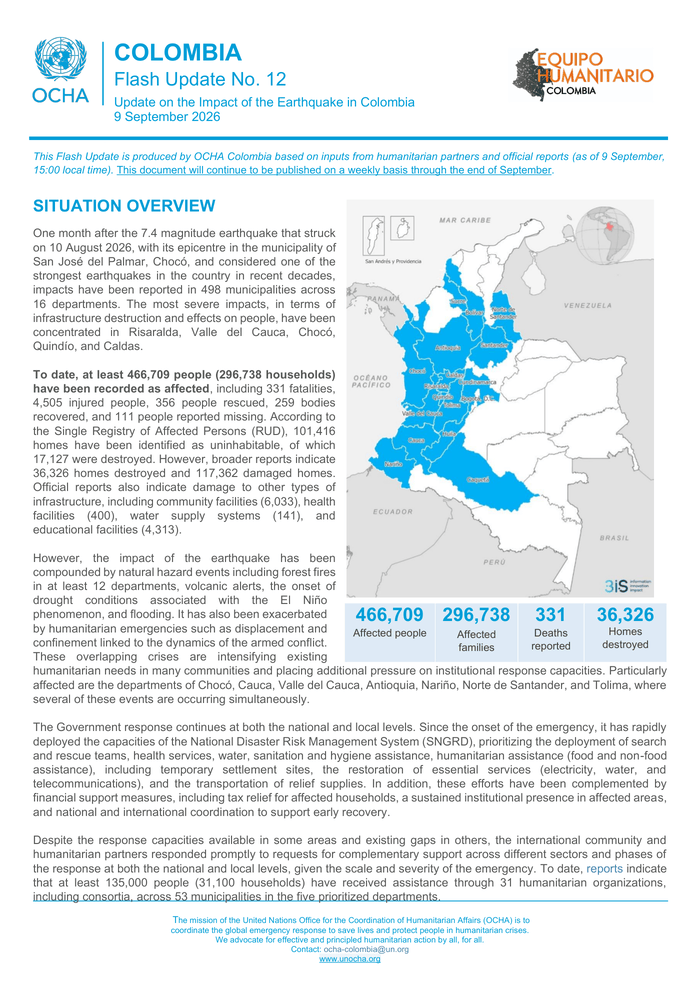
Country: Colombia Sources: El Equipo Humanitario País Colombia, UN Office for the Coordination of Humanitarian Affairs Please refer to the attached file. One month after the earthquake, more than 466, 000 people remain affected across 16 departments. While response and early recovery efforts continue, extensive damage to housing and critical infrastructure is sustaining acute humanitarian needs, particularly in Risaralda, Valle del Cauca, Chocó, Quindío and Caldas. The Government, the National System for Disaster Risk Management (SNGRD) and international partners have assisted more than 135, 000 people through multi-sectoral interventions in 53 priority municipalities. Close coordination among authorities, humanitarian actors and affected communities remains critical to address urgent needs and accelerate sustainable recovery solutions. Recovery efforts face growing challenges amid concurrent crises, including armed conflict, wildfires, drought and flooding. Additional and timely funding is needed to address humanitarian gaps, scale up assistance and support the recovery of affected communities through the end of 2026. The United Nations Development Programme (UNDP), in partnership with the National Unit for Disaster Risk Management (UNGRD) and the National Government, is advancing post-earthquake early recovery efforts. Through thematic coordination platforms, UNDP is supporting resilient and sustainable reconstruction informed by the rapid assessment, which highlights the extent of damage to critical infrastructure.
Colombia: Flash Update 012 – Update on the Impact of the Earthquake in Colombia – September 10, 2026

RELATED ARTICLES


