


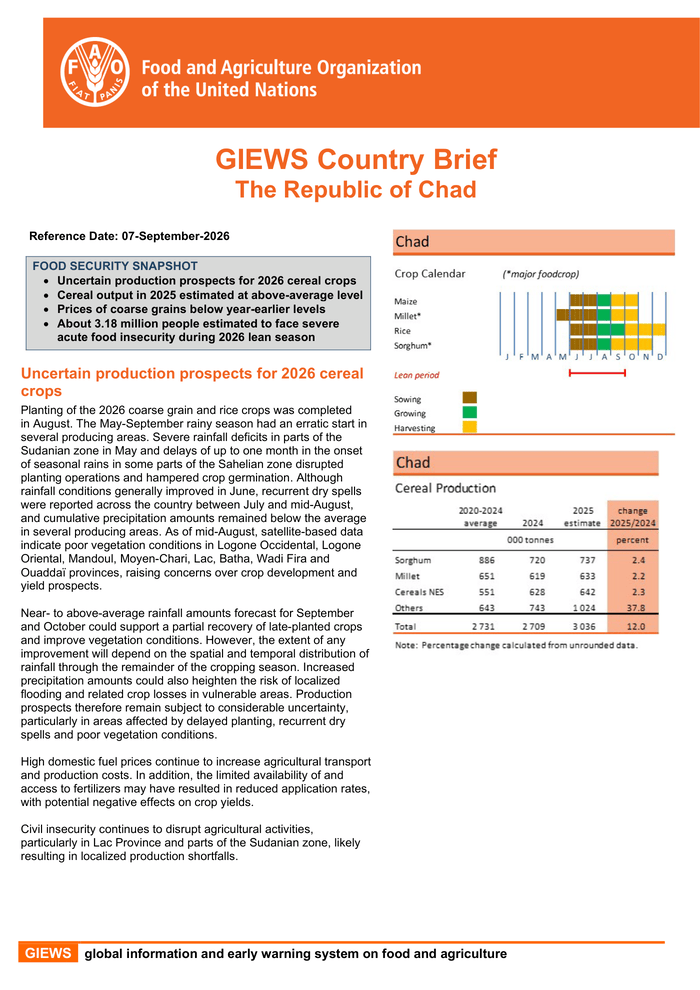
Countries: Chad, Sudan Source: Food and Agriculture Organization of the United Nations Please refer to the attached file. FOOD SECURITY SNAPSHOT Uncertain production prospects for 2026 cereal crops Cereal output in 2025 estimated at above‐average level Prices of coarse grains below year‐earlier levels About 3. 18 million people estimated to face severe acute food insecurity during 2026 lean season Uncertain production prospects for 2026 cereal crops Planting of the 2026 coarse grain and rice crops was completed in August. The May‐September rainy season had an erratic start in several producing areas. Severe rainfall deficits in parts of the Sudanian zone in May and delays of up to one month in the onset of seasonal rains in some parts of the Sahelian zone disrupted planting operations and hampered crop germination. Although rainfall conditions generally improved in June, recurrent dry spells were reported across the country between July and mid‐August, and cumulative precipitation amounts remained below the average in several producing areas. As of mid‐August, satellite‐based data indicate poor vegetation conditions in Logone Occidental, Logone Oriental, Mandoul, Moyen‐Chari, Lac, Batha, Wadi Fira and Ouaddaï provinces, raising concerns over crop development and yield prospects. Near‐ to above‐average rainfall amounts forecast for September and October could support a partial recovery of late‐planted crops and improve vegetation conditions. However, the extent of any improvement will depend on the spatial and temporal distribution of rainfall through the remainder of the cropping season. Increased precipitation amounts could also heighten the risk of localized flooding and related crop losses in vulnerable areas. Production prospects therefore remain subject to considerable uncertainty, particularly in areas affected by delayed planting, recurrent dry spells and poor vegetation conditions. High domestic fuel prices continue to increase agricultural transport and production costs. In addition, the limited availability of and access to fertilizers may have resulted in reduced application rates, with potential negative effects on crop yields. Civil insecurity continues to disrupt agricultural activities, particularly in Lac Province and parts of the Sudanian zone, likely resulting in localized production shortfalls. Cereal output in 2025 estimated at above‐average level The 2025 aggregate cereal production is officially estimated at about 3 million tonnes, approximately 10 percent above the average of the previous five years. Production outcomes, however, varied considerably across regions. Well‐distributed and above‐average rainfall amounts boosted yields in the Sahelian zone, offsetting the lower output harvested in parts of the Sudanian zone, where the delayed onset and erratic distribution of seasonal rains adversely affected crops. Civil insecurity also disrupted agricultural activities, particularly in Lac Province and some southern areas, resulting in localized production shortfalls. Prices of coarse grains below year‐earlier levels Retail prices of locally produced sorghum and millet were stable or rose by up to 15 and 20 percent, respectively, between May and July 2026, while retail prices of local maize followed mixed trends. Despite recent increases, prices of coarse grains in July 2026 were 20 to 45 percent below their year‐earlier levels in most monitored markets, reflecting subdued household demand amid low purchasing power. About 3. 18 million people estimated to face severe acute food insecurity during 2026 lean season According to the latest Cadre Harmonisé (CH) analysis, nearly 3. 18 million people (17 percent of the analysed population) were estimated to face severe acute food insecurity (CH Phase 3 [Crisis] and above) during the June‐August 2026 lean season, including about 241 000 people in CH Phase 4 (Emergency). This marks a slight improvement compared to the same period in 2025, when 3. 31 million people (19 percent of the analysed population) were in CH Phase 3 (Crisis) and above. The sustained influx of people fleeing the conflict in the Sudan has increased the country’s refugee population to about 1. 5 million, two and a half times the level prior the start of the conflict in April 2023. Over the same period, about 401 000 Chadian nationals had returned to the country as of late August 2026. The presence of a large number of displaced people is increasing pressure on local livelihoods, basic services and markets, particularly in eastern provinces. Fluctuations in the pace of refugee arrivals, coupled with deteriorating security conditions, continue to hamper the effective planning and delivery of humanitarian assistance. A separate CH analysis estimated that over 332 000 Sudanese refugees (34 percent of the analysed refugee population) faced severe acute food insecurity between June and August 2026, including about 82 000 people in CH Phase 4 (Emergency). Civil insecurity remains a key driver of acute food insecurity, particularly in Lac Province, where nearly 295 000 people are internally displaced and a state of emergency was in place from May to August 2026 following a series of attacks by non‐state armed groups. Intercommunal conflicts also persist in several areas across the country. The resulting disruptions of livelihoods and trade, coupled with losses of food stocks, has contributed to localized food shortages and elevated prices in affected markets. The poor start of the 2026 rainy season reduced agricultural income‐earning opportunities in affected areas, keeping household incomes below typical seasonal levels and further constraining food access among market‐dependent households. Disclaimer: The designations employed and the presentation of material in this information product do not imply the expression of any opinion whatsoever on the part of FAO concerning the legal status of any country, territory, city or area or of its authorities, or concerning the delimitation of its frontiers or boundaries. This brief was prepared using the following data/tools: FAO/GIEWS Country Cereal Balance Sheet (CCBS) https: //www. fao. org/giews/data-tools/en/. FAO/GIEWS Food Price Monitoring and Analysis (FPMA) Tool https: //fpma. fao. org/. FAO/GIEWS Earth Observation for Crop Monitoring https: //www. fao. org/giews/earthobservation/. Cadre Harmonisé (CH) http: //cadreharmonise. org/.



GrowthPakistan brings you the latest news to keep an eye on Pakistan’s startup ecosystem. Business keeps you growing when you stay aware of your competitors' moves. GrowthPakistan offers Business, Tech, Global Tech, Global, Auto, and Startup News straight from industries all around the globe. This platform will help you identify upcoming opportunities not only in Pakistan but worldwide.
Email : growthpakistan@gmail.com
Whatsapp : +92320-9497079
© growthpakistan