


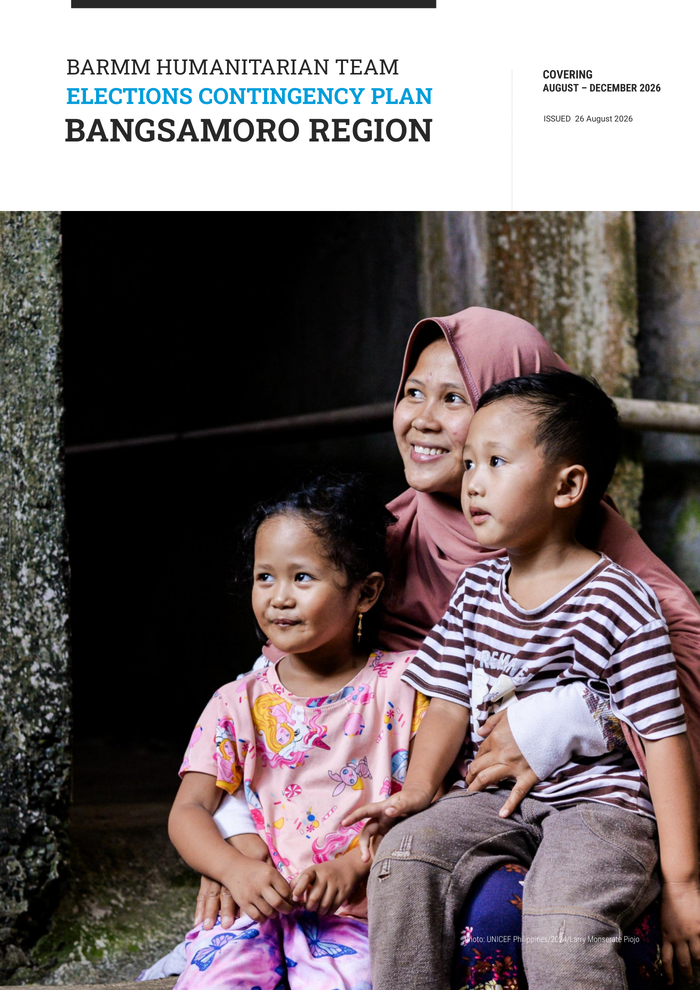
Country: Philippines Sources: UN Office for the Coordination of Humanitarian Affairs, UN Resident Coordinator in the Philippines Please refer to the attached file. The Bangsamoro Autonomous Region in Muslim Mindanao (BARMM) came into force in 2019 with the ratification of Bangsamoro Organic Law (BOL), bringing the Moro Islamic Liberation Front (MILF) into a formal role in the governance of the region through the Bangsamoro Transition Authority (BTA), which continues under the extended transition period. The first elected Parliament will assume office following the BARMM Parliamentary Election scheduled for 14 September 2026. This significant feat that came with the peace agreement brought higher expectations and anticipations from various sectors and stakeholders, a positive peace development in Southeast Asia, that ending decades-old armed struggle by a revolutionary front is possible. This, alongside political developments and preparations for the first BARMM Parliamentary Election, continues to shape the political and security landscape of the region. While succeeding parliamentary elections are seen to galvanise the political track of the peace process, the normalisation track, which includes decommissioning of combatants, is yet to be culminated and other aspects like implementation of socio-economic programs, amnesty, camp transformation, transitional justice and mechanisms are in varying phases of implementation. The region continues to be plagued by insecurities with infighting among non-state armed groups (NSAGs) and armed non-state actors (ANSAs), rido or clan feuds over land and politics dominate local conflict dynamics, causing displacements. As of 7 August 2026, around 250, 000 people remain displaced across Mindanao due to conflict, shocks arising from natural hazards, and long-term crises (OCHA Mindanao Displacement Snapshot). Armed conflict displaced an estimated 13, 387 people in Mindanao between 5 July and 4 August 2026, across a contiguous corridor straddling the Special Geographic Area (SGA) and adjacent North Cotabato. Displacement is heavily concentrated in Barangay Nabalawag, Nabalawag municipality (SGA) on 23 July displaced 12, 055 people. This followed clashes in Barangay Central Labas, Kadayangan (SGA) on 5 July, which displaced 813 people, while two further incidents in North Cotabato displaced 169 people in Matalam on 29 July and 350 people on 4 August (Department of Social Welfare and Development, Disaster Response Operations Monitoring, Information and Communication; DSWD DROMIC). Displacement in Mindanao was significantly higher in January–June 2025 compared to the same period in 2022, reflecting a 12. 7 per cent increase, from 111, 444 to 125, 596 displaced persons. While many displaced families were able to return to their places of origin, recurrent displacement remained a key feature of the displacement landscape. As of June 2025, approximately 67 per cent of remaining displacements were due to armed conflict, 21 per cent to natural hazards, and 2 per cent each to clan feuds and crime and violence (UNHCR Mindanao displacement trends). Based on trends, armed violence peaked during political exercises like in the 2022 national and local elections, the 2023 barangay elections and these continue to manifest in 2024 and the first quarter of 2025 in the lead up to the midterm national and local elections. The presence of armed actors, some included in the peace processes, and the proliferation of firearms, challenge governance, the rule of law, all these contribute to the region’s insecurities and vulnerabilities. These against the backdrop of poverty incidence in the region, at 29. 8 per cent, a progress from 54 per cent in 2018, with a sudden poverty incidence drop in Lanao del Sur from 71 per cent to 10 per cent; nonetheless, the poverty reduction was uneven across the region. Food insecurity in the region is at 38 per cent, compared to the national rate of 15 per cent (WFP VAM Study). Around 68 per cent of children aged 0-17 years old are living in poverty, the highest in the country. Only 37. 2 per cent of households have access to basic sanitation facilities compared to 83. 64 per cent nationally (FHSIS/UNICEF). In terms of grave violations against children documented and verified, 83 per cent are in Mindanao, which includes BARMM (6th SG Report on Children and Armed Conflict CAAC in the Philippines).



GrowthPakistan brings you the latest news to keep an eye on Pakistan’s startup ecosystem. Business keeps you growing when you stay aware of your competitors' moves. GrowthPakistan offers Business, Tech, Global Tech, Global, Auto, and Startup News straight from industries all around the globe. This platform will help you identify upcoming opportunities not only in Pakistan but worldwide.
Email : growthpakistan@gmail.com
Whatsapp : +92320-9497079
© growthpakistan