


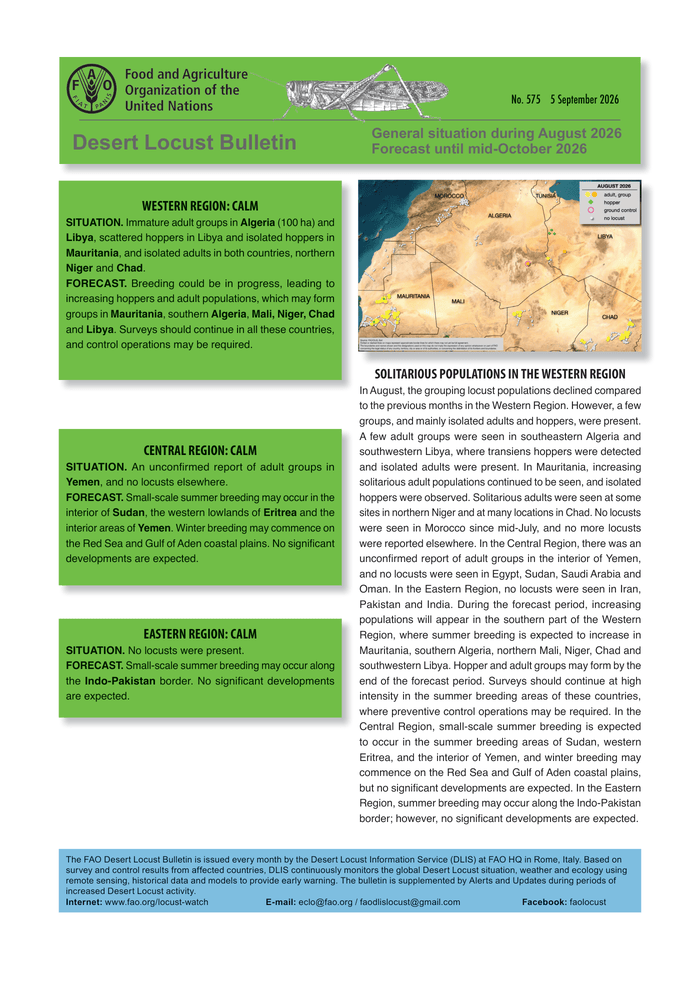
Countries: Algeria, Afghanistan, Benin, Burkina Faso, Cabo Verde, Cameroon, Chad, Côte d’Ivoire, Djibouti, Egypt, Eritrea, Ethiopia, Gambia, Ghana, Guinea, Guinea-Bissau, India, Iran (Islamic Republic of), Liberia, Libya, Mali, Mauritania, Morocco, Niger, Nigeria, Oman, Pakistan, Saudi Arabia, Senegal, Sierra Leone, Somalia, Spain, Sudan, Togo, Tunisia, Yemen Source: Food and Agriculture Organization of the United Nations Please refer to the attached file. SOLITARIOUS POPULATIONS IN THE WESTERN REGION In August, the grouping locust populations declined compared to the previous months in the Western Region. However, a few groups, and mainly isolated adults and hoppers, were present. A few adult groups were seen in southeastern Algeria and southwestern Libya, where transiens hoppers were detected and isolated adults were present. In Mauritania, increasing solitarious adult populations continued to be seen, and isolated hoppers were observed. Solitarious adults were seen at some sites in northern Niger and at many locations in Chad. No locusts were seen in Morocco since mid-July, and no more locusts were reported elsewhere. In the Central Region, there was an unconfirmed report of adult groups in the interior of Yemen, and no locusts were seen in Egypt, Sudan, Saudi Arabia and Oman. In the Eastern Region, no locusts were seen in Iran, Pakistan and India. During the forecast period, increasing populations will appear in the southern part of the Western Region, where summer breeding is expected to increase in Mauritania, southern Algeria, northern Mali, Niger, Chad and southwestern Libya. Hopper and adult groups may form by the end of the forecast period. Surveys should continue at high intensity in the summer breeding areas of these countries, where preventive control operations may be required. In the Central Region, small-scale summer breeding is expected to occur in the summer breeding areas of Sudan, western Eritrea, and the interior of Yemen, and winter breeding may commence on the Red Sea and Gulf of Aden coastal plains, but no significant developments are expected. In the Eastern Region, summer breeding may occur along the Indo-Pakistan border; however, no significant developments are expected.



GrowthPakistan brings you the latest news to keep an eye on Pakistan’s startup ecosystem. Business keeps you growing when you stay aware of your competitors' moves. GrowthPakistan offers Business, Tech, Global Tech, Global, Auto, and Startup News straight from industries all around the globe. This platform will help you identify upcoming opportunities not only in Pakistan but worldwide.
Email : growthpakistan@gmail.com
Whatsapp : +92320-9497079
© growthpakistan