


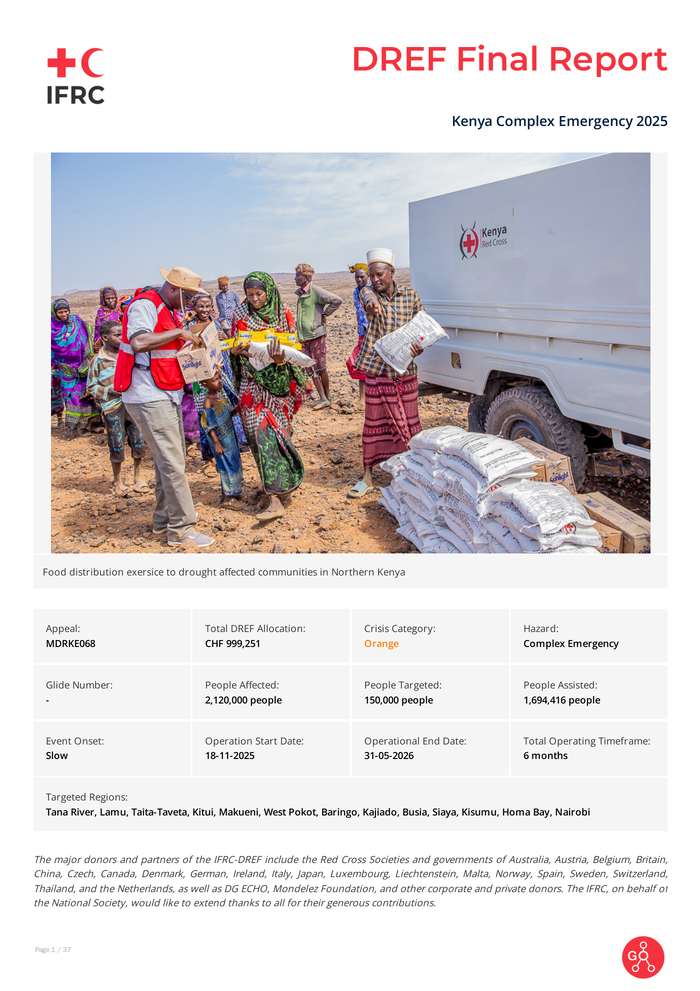
Country: Kenya Source: International Federation of Red Cross and Red Crescent Societies Please refer to the attached file. Description of the Event Date when the trigger was met 22-10-2025 What happened, where and when? Kenya experienced a prolonged and severe drought emergency driven by consecutive below-average rainfall seasons, prolonged dry spells, and the cumulative impacts of climate variability across the country’s Arid and Semi-Arid Lands (ASALs). The drought resulted in widespread depletion of water sources, reduced pasture and browse availability, declining livestock productivity, increased livestock losses, reduced household food availability, and worsening livelihood insecurity among pastoral and agro-pastoral communities. The crisis affected vulnerable households that rely heavily on rain-fed agriculture and livestock-based livelihoods. As the drought persisted, communities increasingly adopted negative coping strategies, including reducing food consumption, selling productive assets, migrating in search of water and pasture, and increasing reliance on humanitarian assistance. By the end of the operation in May 2026, drought impacts continued to affect vulnerable populations despite localized improvements following the March–May 2026 rains. The humanitarian situation remained fragile, with several ASAL counties experiencing Crisis food insecurity conditions (IPC Phase 3) and some vulnerable populations facing heightened risks of acute malnutrition, disease outbreaks, and loss of livelihoods. The drought emergency was compounded by reduced humanitarian funding, limiting the ability of partners to sustain assistance at the required scale. Additionally, emerging climate-related shocks, including flooding in some parts of the country during the MAM 2026 rainy season, placed further pressure on already vulnerable communities and humanitarian resources. The drought primarily affected Kenya’s Arid and Semi-Arid Lands (ASALs), particularly pastoral and agro-pastoral counties in northern and eastern Kenya. The DREF-supported response targeted some of the most drought-affected areas, including: _ North Eastern Region (Mandera, Wajir and Garissa) – including vulnerable pastoral communities experiencing severe water shortages, reduced livestock productivity, and food insecurity. _ South Rift Refion (Baringo County and Narok County) – particularly drought-affected communities dependent on pastoralism and mixed livelihoods. _ North Rift Region– Counties affected by prolonged drought conditions, limited water availability, and declining livestock-based livelihoods. _ Coast Region– where pastoral households faced reduced access to water, pasture, and essential services. _ Lower Eastern and Upper Eastern Regions – where drought impacts affected pastoral livelihoods, food security, and access to basic services. The broader national drought response covered multiple ASAL counties, with KRCS supporting interventions including emergency food assistance, cash voucher assistance, water trucking, rehabilitation of community water systems, nutrition support, and livestock interventions across affected pastoral areas. The drought emergency developed over several consecutive seasons following below-average rainfall and failed or poor-performing rainy seasons in Kenya’s ASAL regions. The humanitarian situation intensified during the 2024–2025 period, with the impacts continuing into 2026 due to prolonged livelihood depletion and slow recovery among affected communities. At the time of the DREF implementation period, the crisis had reached a critical stage, with the 2025 lean season showing a significant increase in acute food insecurity compared to previous years. Humanitarian needs remained elevated into May 2026, despite some temporary improvements associated with the March–May 2026 rainfall season. The DREF operation was therefore implemented during a period of heightened vulnerability to provide timely humanitarian assistance, protect lives and livelihoods, and address urgent needs related to food security, nutrition, water access, health, and livelihood support among drought-affected communities. The trigger for a Disaster Response Emergency Fund (DREF) was met in October 2025 which lead to the launch of this DREF in November 2025. Owing to the scale of



GrowthPakistan brings you the latest news to keep an eye on Pakistan’s startup ecosystem. Business keeps you growing when you stay aware of your competitors' moves. GrowthPakistan offers Business, Tech, Global Tech, Global, Auto, and Startup News straight from industries all around the globe. This platform will help you identify upcoming opportunities not only in Pakistan but worldwide.
Email : growthpakistan@gmail.com
Whatsapp : +92320-9497079
© growthpakistan